Nutopia...
This is a mythical country created by John and Yoko in 1973. It was announced on the Mind Games album, which included the Nutopian International Anthem, a track which contained only a few seconds of silence. John and Yoko wrote of Nutopia on the inner sleeve of the album (see text below). Their imaginary realm required its citizens to have no passports. It was a place without boundaries. And John and Yoko invited everyone to pledge their allegiance to Nutopia, whose flag was pure white and whose system of government was that of Cosmic Law. John and Yoko also requested that Nutopia be admitted to the United Nations.
John and Yoko at their press conference to announce Nutopia on April 1, 1973.
This all stemmed from John’s ongoing immigration problems, the battle he had to constantly fight just to stay in America. On March 23, 1973, John was given a final order to leave the US within 60 days, while Yoko was allowed to remain indefinitely. The attempt to split the Lennons up soon achieved its purpose, although not in the way the government expected (John and Yoko would separate for 18 months due to the intolerable level of stress in their relationship). The announcement of Nutopia came soon after this, on April 1 (April Fools Day), at a press conference in New York (there are photos that were taken on this day of John and Yoko waving the white flags--actually tissues--of Nutopia). This bizarre event signaled John’s retirement from active political life.
Here is the official declaration of Nutopia from the Mind Games liner notes:
DECLARATION OF NUTOPIA
We announce the birth of a conceptual country, NUTOPIA.
Citizenship of the country can be obtained by declaration of your awareness of NUTOPIA.
NUTOPIA has no land, no boundaries, no passports, only people.
NUTOPIA has no laws other than cosmic.
All people of NUTOPIA are ambassadors of the country.
As two ambassadors of NUTOPIA, we ask for diplomatic immunity and recognition in the United Nations of our country and our people.
YOKO ONO LENNON (with signature)
JOHN ONO LENNON (with signature)
Nutopian Embassy
One White Street
New York, New York 10012
April 1, 1973
Bookshelf - John Lennon: Whatever Gets You Through The Night

John Lennon: Whatever Gets You Through The Night
The Stories Behind Every John Lennon Song 1970-1980
by Paul Du Noyer
"I like to write about me, because I know about me." -John Lennon
Idealist, joker, showman, activist, poet and musician. John Lennon influenced a generation with his songs. This is the only book to explore the stories and thinking behind every song he recorded after The Beatles' breakup in 1970 - from the idealism and inner doubt of Imagine to the reaffirming love songs of Double Fantasy. Once free of The Beatles, John's style became more confessional than ever. "Imagine," "Mind Games," "Instant Karma": Lennon approach each song as another installment of his childhood, the bitter legacy of the Beatles, his love for Yoko, as well as his infidelities and his insecurity. There are also the classic anthems of social protest, like "Give Peace a Chance," "Power to the People," and "Working Class Hero." Even his choice of covers like "Standy by Me" and "Be-Bop-A-Lula," tells us much about his musical roots. Finally there are John's accounts of his domestic contentment and optimism for the future.
Illustrated throughout, this is essential reading for everyone who has been moved by the lyrics of one of the icons of pop culture.
Paul Du Noyer was born in Liverpool and educated at the London School of Economics. He is a rock journalist in London, and has written and/or edited for NME, Q, Mojo and The Story of Rock 'n' Roll.
Excerpt:SHINING ON
The world knew him as a man of peace, but John Lennon was born in violence. And he died in violence, too. He came into the world on 9 October 1940, when Liverpool was being bombed to rubble by Hitler's air force. The Oxford Street Maternity Hospital stood on a hill above the city centre; below it were the docks that had made the seaport great, but were now earning it a terrible punishment. Liverpool was Pearl Harbour every night in those war years, and thousands perished in terrace slums or makeshift shelters. But Julia Lennon's war baby survived, and she took it home unharmed. All around them was the din of sirens and explosions.
The Lennons' house was small, in a working class street off Penny Lane; John's father, Freddie, was away at sea. Liverpool was where generations of new Americans took their leave of Europe, and its maritime links with New York stayed strong. Freddie Lennon was like many Liverpudlian men, who knew the bars of Brooklyn better than the palaces of London. "Cunyard Yanks" became a source of the US R&B records that made Liverpool a rock'n'roll town. Black American music found a ready market in this port, which had grown rich by selling the slaves of Africa to the masters of the New World. In a park near John's home stood a statue of Christopher Columbus, inscribed: "The discoverer of America was the maker of Liverpool."
John was of the usual local stock, not so much English as Welsh and Irish. The latter, especially, had dominated Liverpool since the mass migrations of the famine years. They gave the Lancashire town a hybrid accent all of its own, which John never lost. The Celtic stereotypes were always applied to Liverpool - violent and sentimental, lovers of music and words, witty and democratic. Far from breaking the mould, Lennon was that stereotype made flesh.
But his upbringing was traditionally British. His respectable Aunt Mimi looked after John from the age of five. With her husband George Smith she raised the boy in a neat, semi-detached house in Menlove Avenue, on Liverpool's outskirts. Post-war Britain was still subject to scarcity and rationing ("G is for orange," went John's poem Alphabet, "which we love to eat when we can get them"), but his circumstances were comfortable. He had a loving home, and was educated at Quarry Bank, one of the city's better state schools. His background was not as deprived as he sometimes implied.
Yet he could not forget that his natural parents had deserted him. Freddie left Julia, and Julia did not want her infant John. It was not until his teens that John would see his mother regularly, whereupon she was killed in a road accident. The tragedy seems to have compounded John's sense of isolation. As a child, he claims, he used to enter deep states of trance. He liked to paint and draw, and loved the surrealistic, "nonsense" styles of Lewis Carroll, Edward Lear and Spike Milligan. But his quick mind made him a rebel rather than an academic achiever. To Liverpool suburbanites of Mimi's generation, the city accent meant a lack of breeding, while shaggy hair and scruffy clothes awoke pre-war memories of poverty. John made it his business to embrace all those things.
Rock'n'roll was his salvation, arriving like a cultural H-bomb in mid-Fifties Britain when John was 15. But his musical education began earlier. As Yoko wrote in the sleevenotes to Menlove Avenue, a compilation featuring some of John's Fifties favourites, "John's American rock roots. Elvis, Fats Domino and Phil Spector are evident in these tracks. But what I hear in John's voice are the other roots of the boy who grew up in Liverpool, listening to 'Greensleeves', BBC Radio and Tessie O'Shea." As well as the light classics and novelty songs of that pre-television era, John learned many of the folk songs still sung in Liverpool ('Maggie May' among them) and the hymns he was taught in Sunday school. Like his near neighbour Paul McCartney, Lennon's subconscious understanding of melody and harmony, if not of rhythm, was already being formed many years before his road-to-Damascus encounters with Bill Haley's 'Rock around the Clock' and Elvis Presley's 'Heartbreak Hotel'.
By the dawn of the 1960s, when John's old skiffle band the Quarry Men had evolved into Liverpool's top beat group, the Beatles, he'd absorbed rock'n'roll into his bloodstream. The town's cognoscenti were by this time devouring the sounds of Brill Building pop or rare imports of Tamla Motown soul. When Lennon and McCartney made their first, hesitant efforts to write songs instead of copying American originals, their imaginations were a ferment of influences. Country and western was the city's most popular live music, which is why the Beatles' George Harrison became a guitar picker instead of a blueswailer like Surrey boy Eric Clapton. Then there was anything from Broadway shows to football chants, to family memories of long-demolished music halls.
More than all of these, there was Lennon and McCartney's innate creative talent. They inspired each other, at first as friends and then as rivals. Their band, the Beatles, was simultaneously toughened and sensitized by countless shows in Hamburg, the Cavern and elsewhere. And in London they met George Martin, who was surely the most intuitive producer they could ever have worked with. Finally on their way, the Beatles were world-conquering and unstoppable.
All this was not enough for Lennon. Millions adored 'Please Please Me', 'She Loves You' and 'I Want To Hold Your Hand', but John soon tired of any formula, however magical. Hearing the songs of Bob Dylan, he was stung into competing as a poet. Turning inwards to his own state of turmoil, he yearned to test his powers of self-expression. He began lacing the Beatles' repertoire with songs of dark portent, such as 'I'm a Loser' and 'You've Got To Hide Your Love Away'. Attempting his most naked statement so far, he wrote a song that he simply called 'Help!' - but the conventions of Top 20 pop music ensured that nobody guessed he meant it.
As the Beatles gradually began to disappear behind moustaches and a sweet-scented, smoky veil, Lennon's lyrics moved towards more complex and original imagery. And yet paradoxically, there was greater self-revelation. 'Norwegian Wood', 'Tomorrow Never Knows', 'Strawberry Fields Forever' - while these songs were often suffused with gnomic mystery, the emotional presence of their creator remained unmistakable. He disclaimed the everyday, anecdotal songs that had become Paul's hallmark. "I like to write about me," he told Playboy magazine in 1980, "because I know me. I don't know anything about secretaries and postmen and meter maids."
His unthinking honesty almost killed him in 1966. A casual comment to a London newspaper - that the Beatles were more popular than Jesus - was shrugged off in Britain but summoned forth a torrent of death threats from America. "It put the fear of God into him," remembers Paul McCartney. "Boy, if there was one point in John's life when he was nervous. Try having the whole Bible Belt against you, it's not so funny." Coming through that, and having resolved the Beatles would not tour any more, John was ready for something else to happen in his life.
What happened was a woman named Yoko Ono. A Japanese artist, she arrived as if from nowhere and revolutionized John Lennon's life. "She came in through the bathroom window," he joked in 1969.
Look inside the book
Buy (circa $7)
Unreleased Songs By The Beatles, 1962-1964
LEGEND for available Beatles recordings
STUDIO: Studio outtake. A copy resides in the EMI archives.
DEMO: Home demo.
BBC: Recorded for the British Broadcasting Corporation. Recording date is indicated unless otherwise noted.
GBS: Get Back sessions, recorded at Twickenham Film Studios / Apple Studios, January 2-31, 1969.
LIVE: Live recording.
DECCA: Demo recorded for Decca Records.
LEGEND for unavailable Beatles recordings
BBCx: Recorded for the British Broadcasting Corporation, not aired.
LIVEx: Performed live, unavailable (specific years are indicated in brackets).
STUDIOx: Studio outtake. Tape destroyed.
LEGEND for official releases
Format: Title, year of release (catalogue number)
.jpg)
1962
Beautiful Dreamer (Foster)
LIVEx (1962-1963)
BBC Saturday Club – January 22, 1963
Bring It On Home To Me (Cooke)
LIVEx (1962)
GBS – January 3, 1969
Don’t Ever Change (Goffin/King)
LIVEx (1962)
BBC Pop Go The Beatles – August 1, 1963*
*Released on:
CD: Live at the BBC, 1994 (Capitol CDP 8 31796 2)
Dream Baby (How Long Must I Dream) (Walker)
LIVEx (1962)
BBC Teenager’s Turn (Here We Go) – March 7, 1962
LIVE Cavern Club, Liverpool – July, 1962
Hey! Baby (Channel/Cobb)
LIVEx (1962)
LIVE Cavern Club, Liverpool – July, 1962
Hey Let’s Twist (Glover/Dee/Levy)
LIVEx (1962)
How Do You Do It (Murray)
STUDIO – September 4, 1962*
LIVEx (1962)
*Released in edited form on:
CD: Anthology 1, 1995 (EMI CDP 7243 8 34445 2)
I Fancy Me Chances (Lennon/McCartney)
LIVEx (1962)
GBS – January 24, 1969*
*Released in edited form on:
CD: Let It Be... Naked, 2003 (Apple/Capitol CDP 7243 5 95227 2 2)
I Remember You (Mercer/Schertzinger)
LIVEx (1962)
LIVE Hamburg, Germany – December 25, 1962
Released on:
LP: Live! At The Star-Club, 1977 (Atlantic/Lingasong LS-2-7001)
If You Gotta Make A Fool Of Somebody (Clark)
LIVEx (1962)
LIVE Cavern Club, Liverpool – July, 1962
I’m Talking About You (Berry)
LIVEx (1962)
LIVE Hamburg, Germany – December 25, 1962*
LIVE Hamburg, Germany – December 28, 1962
BBC Saturday Club – March 16, 1963
GBS – January 6, 10 & 25, 1969
*Released on:
LP: Live! At The Star-Club, 1977 (Atlantic/Lingasong LS-2-7001)
The Loco-Motion (Goffin/King)
LIVEx (1962-1963)
Love Is A Swingin’ Thing (Owens/Dixon/Denson)
LIVEx (1962)
GBS – January 24, 1969
Main Title Theme (The Man With The Golden Arm) (Bernstein)
LIVEx (1962)
Mama Said (Dixon/Denson)
LIVEx (1962)
Nobody But You (Bonner/Bonarrigo)
LIVEx (1962)
Open (Your Lovin’ Arms) (Knox)
LIVEx (1962)
Peppermint Twist (Dee/Glover)
LIVEx (1962)
Vocal by Pete Best
A Picture Of You (Beveridge/Oakman)
LIVEx (1962)
BBC Here We Go – June 11, 1962
Pinwheel Twist (Lennon/McCartney)
LIVEx (1962)
Reminiscing (Curtis)
LIVEx (1962-1963)
LIVE Hamburg, Germany – December 31, 1962
Sharing You (Goffin/King)
LIVEx (1962)
LIVE Cavern Club, Liverpool – July, 1962
Sheila (Roe)
LIVEx (1962-1963)
BBCx Here We Go – October 25, 1962
LIVE Hamburg, Germany – December 25, 1962*
*Released on:
LP: Live! At The Star-Club, 1977 (Atlantic/Lingasong LS-2-7001)
A Shot Of Rhythm And Blues (Thompson)
LIVEx (1962)
BBC Pop Go The Beatles – June 1, 1963
BBC Easy Beat – July 17, 1963
BBC Pop Go The Beatles – August 1, 1963*
GBS – January 7, 1969
*Released on:
CD: Live at the BBC, 1994 (Capitol CDP 8 31796 2)
Skinny Minnie (Haley/Keefer/Gabler/Cafra)
STUDIOx Hamburg, Germany – April 23-27, 1962
Soldier Of Love (Lay Down Your Arms) (Cason/Moon)
LIVEx (1962)
BBC Pop Go The Beatles – July 2, 1963*
GBS – January 24, 1969
*Released on:
CD: Live at the BBC, 1994 (Capitol CDP 8 31796 2)
Some Other Guy (Leiber/Stoller/Barrett)
LIVEx (1962-1963)
LIVE Liverpool, England – August 22, 1962
LIVE Liverpool, England – September 5, 1962
BBC Saturday Club – January 22, 1963
BBC Talent Spot – January 22, 1963
BBC Easy Beat – June 19, 1963*
*Released on:
CD: Live at the BBC, 1994 (Capitol CDP 8 31796 2)
Theme For A Dream (Miller)
LIVEx (1962)
There’s No One In The Whole Wide World (Pavey/Schroeder)
LIVEx (1962)
Tip Of My Tongue (McCartney)
LIVEx (1962)
STUDIOx – November 26, 1962
Released by Tommy Quickly on:
45: «Tip Of My Tongue»/«Heaven Only Knows», 1963 (UK: Piccadilly 7N 35137)
What A Crazy World We’re Living In (Klein)
LIVEx (1962)
Where Have You Been (All My Life) (Mann/Weil)
LIVEx (1962)
LIVE Hamburg, Germany – December 28, 1962*
*Released on:
LP: Live! At The Star-Club, 1977 (Atlantic/Lingasong LS-2-7001)
When My Little Girl Is Smiling (Goffin/King)
LIVEx (1962)
1963
All I Want For Christmas Is A Beatle (Benton)
BBC Saturday Club – December 17, 1963
Bad To Me (Lennon)
DEMO – May, 1963
Released by Billy J. Kramer with The Dakotas on:
45: «Bad To Me»/«I Call Your Name», 1963 (US: Liberty 55626, UK: Parlophone R 5049)
Chrimble Medley (arr. Lennon/McCartney)
BBC Saturday Club – December 17, 1963
Features «Shazam» (Eddy/Hazlewood)/«Love Me Do»/«Please Please Me»/«From Me To You»/«She Loves You»/«I Want To Hold Your Hand»/«Rudolph The Red Nosed Reindeer» (Marks)
Diamonds (Lordan)
LIVEx (1963)
From Us To You (Lennon/McCartney)
BBC From Us To You – December 18, 1963
BBC From Us To You – February 28, 1964*
*Released on:
CD: Live at the BBC, 1994 (Capitol CDP 8 31796 2)
Happy Birthday To You (Hill/Hill)
BBC Pop Go The Beatles – June 1, 1963
BBC Saturday Club – September 7, 1963
BBC From Us To You – May 1, 1964
I’ll Keep You Satisfied (Lennon/McCartney)
Released by Billy J. Kramer with The Dakotas on:
45: «I’ll Keep You Satisfied»/«I Know», 1963 (US: Liberty 55643, UK: Parlophone R 5073)
I’m In Love (Lennon)
DEMO – October, 1963
Released by the Fourmost on:
45: «I’m In Love»/«Respectable», 1963 (US: ATCO 6285, UK: Parlophone R 5078)
Keep Your Hands Off My Baby (Goffin/King)
LIVEx (1963)
BBC Saturday Club – January 22, 1963*
*Released on:
CD: Live at the BBC, 1994 (Capitol CDP 8 31796 2)
Let’s Stomp (Goldstein/Feldman/Gottehrer)
LIVEx (1963)
Moonlight Bay (Madden/Wenrich)
LIVE Elstree Studio Centre, Borehamwood, Hertfordshire – December 2, 1963*
*Released on:
CD: Anthology 1, 1995 (EMI CDP 7243 8 34445 2)
Pop Go The Beatles (trad. arr. Patrick)
BBC Pop Go The Beatles – May 24, 1963
BBC Pop Go The Beatles – July 2, 1963
Side By Side (Woods)
BBC Side By Side – April 1, 1963
Tie Me Kangaroo Down, Sport (Harris)
BBC From Us To You – December 18, 1963
Walk Right In (Cannon/Woods/Darling/Svanoe)
LIVEx (1963)
Waltzing Matilda (Patterson)
LIVE Royal Albert Hall, London – April 18, 1963
Rockin’ And Rollin’ (Lennon/McCartney)
Tammy Tell Me True (Squires)
Three Coins In A Fountain (Styne/Cahn)
DEMO – July, 1963
1964
Bouree (Bach)
LIVE Hotel Saint George, Wellington – June 23, 1964
From A Window (McCartney)
Released by Billy J. Kramer with The Dakotas on:
45: «From A Window»/«Second To None», 1964 (US: Imperial 66051, UK: Parlophone R 5156)
I Don’t Want To See You Again (McCartney)
Released by Peter & Gordon on:
45: «I Don’t Want To See You Again»/«I Would Buy You Presents», 1964 (US: Capitol 5272, UK: Columbia DB 7356)
It’s For You (McCartney)
DEMO EMI Studios, England – June 3, 1964
Released by Cilla Black on:
45: «It’s For You»/«He Won’t Ask Me», 1964 (US: Capitol 5258, UK: Parlophone R 5162)
Nobody I Know (McCartney)
Released by Peter & Gordon on:
45: «Nobody I Know»/«You Don’t Have To Tell Me», 1964 (US: Capitol 5211, UK: Columbia DB 7292)
One And One Is Two (Lennon/McCartney)
DEMO – January, 1964
Released by the Strangers with Mike Shannon on:
45: «One And One Is Two»/«Time And The River», 1964 (UK: Phillips BF 1335)
Talking Guitar Blues (trad. arr. Tubb)
LIVE Deauville Hotel, Miami – February 21, 1964
White Christmas (Berlin)
LIVE Carnegie Hall, New York – February 12, 1964
Won’t You Be My Baby (Devlin/McCartney)
Released by Johnny Devlin & The Devils on:
45: «Won’t You Be My Baby», 1965 (Australia: RCA 101591)
You Know What To Do (Harrison)
DEMO EMI Studios, England – June 3, 1964*
*Released on:
CD: Anthology 1, 1995 (EMI CDP 7243 8 34445 2)

Many thanks to Lifeofthebeatles...
A Hard Day's Night - on pink vinyl!
Though many questions about its origin and purpose still remain unanswered, there is no question that this pink vinyl 1964 stereo issue of A Hard Day's Night is one of the world's most valuable records. This copy, discovered in California, is the only known one to surface so far, and was sold for nearly $10,000.00.
It Was (unreleased) Twenty Years Ago Today...
Girl / You're Going To Lose That GirlTwenty years ago, this Capitol single (# 4506) was going to be released as a single from the Love Songs album, but was withdrawn at the last minute. Thousands of picture sleeves and a small quantity of promotional copies of the record were already made up, and quickly found their way onto the collectors market. The stock labels had already been printed up as well.
In late 1978 two west coast USA dealers purchased the entire lot of 16,000 pictures sleeves for $3,200.00 ($.20 each!). They were initially sold at retail prices of around $30-$40.00, and wholesale for around $2-$5.00 each. Throughout the years the retail price gradually declined to $8.00, and now, twenty years later, they are back up to $20.00 as most of the supply has finally been depleted. Both dealers hesitated in their purchase - even though .20 each was a bargain, it was a lot of money when multiplied by 16,000. They had some idea that it would take "forever" to sell all of the sleeves, and recently stated that they would have never guessed it was to take twenty years!
Issued in October 1977, only a small quantity of promotional copies ever turned up, and today are worth nearly $200.00. In 1978, a few months after the single was withdrawn, bootleggers cleverly ran off stock copies of the single, which never had originally existed. They were pressed using several different colors of vinyl. Close inspection of the labels reveals slightly less detail, and they are also lighter.
The clear vinyl stock issue bootleg.The ONLY Girl singles that are real are the promotional copies on black vinyl - all color vinyl "stock" issues are fake.
Uncut label for the stock issue Girl single.Better late...
Beatles' Memorabilia
John Lennon's military style suitPrototype soldier boy suit made for John Lennon for the Beatles’s second film ‘Help!’. The suit was made in 1965 by Douglas Millings. Between late 1962 and 1967 Dougie and his son Gordon made all of the Beatles suits for stage, film and touring, plus some of their everyday clothes.

John Lennon's brown suede jacket
Brown suede jacket worn by John Lennon during the 1963 recording of 'With the Beatles' and during the band's 1964 tour. Made by Cecil Gee.
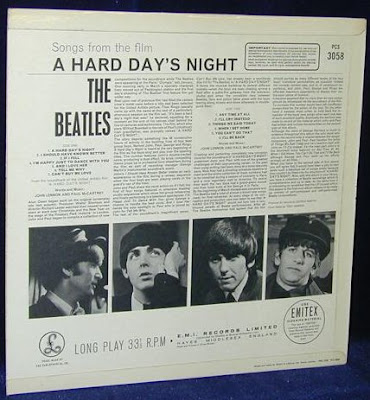
Beatles Official Releases Story - A Hard Day's Night
Label: Parlophone
Catalogue No.'s PMC 1230 (Mono) PCS 3058 (Stereo) CDP 7 46437 2 (C.D.)
Matrix No.'s:
Mono : XEX 481-3N XEX 482-3N
Stereo: YEX 126-1 YEX 127-1
1973 - Stereo: YEX 126-2 YEX 127-4
1995 - Mono : XEX 481-1-1-2 XEX 482-1-1-1
Release dates 10th July 1964
26th February 1987 (CD)
Side 1
A Hard Day's Night Lennon-McCartney Recorded 16th April 1964 in 9 takes (4 of which were breakdowns)
Final mix - take 9. 2:29
I Should Have Known Better Lennon-McCartney Recorded 25th February 1964 with 3 takes
Recorded 26th February 1964 a further 19 takes (4-22)
Final mix - take 9 with overdubs from take 22. 2:41
If I Fell Lennon-McCartney Recorded 27th February 1964 in 15 takes
Final mix - take 15. 2:18
I'm Happy Just To Dance With You Lennon-McCartney Recorded 1st March 1964 in 4 takes
Final mix - take 4. 1:55
And I Love Her Lennon-McCartney Recorded 25th February 1964 with 2 takes (discarded version)
Recorded 26th February 1964 a further 17 takes (3-19)
Recorded 27th February 1964 a further 2 takes (20-21)
Final mix - take 21 2:28
Tell Me Why Lennon-McCartney Recorded 27th February 1964 in 8 takes
Final mix - take 8. 2:06
Can't Buy Me Love Lennon-McCartney Recorded 29th January 1964 (in Paris !) in 4 takes
Final mix - take 4. 2:11
Side 2
Any Time At All Lennon-McCartney Recorded 2nd June 1964 in 11 takes
Final mix - take 11. 2:10
I'll Cry Instead Lennon-McCartney Recorded 1st June 1964 in 8 takes
Final mix - take 6 & take 8 edited together. 1:44
Things We Said Today Lennon-McCartney Recorded 2nd June 1964 in just 3 takes
Final mix - take 3. 2:35
When I Get Home Lennon-McCartney Recorded 2nd June 1964 in 11 takes
Final mix - take 11. 2:15
You Can't Do That Lennon-McCartney Recorded 25th February 1964 in 9 takes (5 breakdowns)
Final mix - take 9. 2:33
I'll Be Back Lennon-McCartney Recorded 1st June 1964 in 16 takes (Takes 1-9 backing track only)
Final mix - take 16. 2:20
Total time 29:45
U.K. Album Chart Detail : Entry Date : 18th July 1964
Highest Position : 1 ... for 21 weeks from 25th July 1964 (CONSECUTIVELY !)
Weeks in Chart : 38
+1 week 16th January 1971 (No.30)
+4 from 7th March 1987 (CD release, reached no.30)
Detail : The Beatles third official L.P. release.
Once again The Beatles had advance orders of over 250,000 copies, ensuring an immediate number 1.
By the end of the year it had sold 600,000, eventually selling almost 800,000 copies in Britain. Once again, the American version of this album was different, in that it only featured the tracks from the film, plus some George Martin film score. The remaining tracks appearing on a second L.P. entitled "Something New". With these two selling over three million in the States, global sales of "A Hard Day's Night" can be put at over 4,000,000.
For the week of 5th August 1964, for the first (and only ?) time in history The Beatles were No.1 in the album AND singles chart in the U.K. AND America with the same titled single and L.P. - "A Hard Day's Night".
This is the first and ONLY Beatles album to have every track written by Lennon/McCartney, with the seven tracks on side 1 all included in the film, and the six on side 2 not featured.
The album was also part of "The Beatles Collection" 13 album box set (see Beatles Collection).
On 26th February 1987 this album had it's first release on C.D. which was published in Mono(!) with a catalogue number of CDP 7 46437 2
And on the same day, the record shop H.M.V. produced a special 12" numbered 4 CD Box Set Comprising:
Please Please Me
With The Beatles
A Hard Days Night
Beatles For Sale
+ Bill Harry - "Book Of Beatle Lists" (see Book of Beatle Lists, The)
This set had a catalogue number of BEA CD 25, and was in a limited edition of just 2,500 copies.
The C.D. was also part of "The Beatles Box" 15 C.D. box set (see Beatles C.D. Box).
The album was also available on 4" reel-to-reel tape,
1964 - Catalogue number TA-PMC 1230 (3¾ ips twin-track mono tape) - first edition (mono only) in a cardboard box.
1968 - Catalogue number TA-PMC 1230 (3¾ ips twin-track mono tape)
TD-PCS 3058 (3¾ ips 4-track stereo) these editions in a "jewel" box.
Prior to 1973:
The album was released on stereo cassette tape (1⅞ ips) - Catalogue number - TC-PCS 3058.
The album was also released on 8-track stereo continuous play cartridge (3¾ ips) - catalogue no. 8X-PCS 3058
In November 1987 the album was re-released on cassette tape (mono only) - Catalogue number - TC-PMC 1230 (originally released August 1964).
U.S. Import
This was an essential import purchase in 1964 as the American version of the album contained the Beatle songs from the film (no extra's !) ... and four orchestral pieces from the film by The George Martin Orchestra.
This release was on the United Artists label (catno. UAS 6366) as they had the rights to the film soundtrack (they were the film distributors).
In the U.S. "A Hard Day's Night" had advance orders of over 1 million before it's release date of 26th June 1964, and had sold 2 million just three months later, making it one of the fastest selling albums ever.
It was number one in the U.S. for 14 weeks.
The sleeve for the U.S. release can be seen at the end of this page.
Mono/Stereo Differences
"A Hard Day's Night" The stereo version is a few seconds longer than the mono version.
"I Should Have Known Better" The stereo version has a brief gap in the harmonica intro, whereas the mono version is complete.
The stereo version has four repeats of the closing line, the mono has only three.
"If I Fell" The stereo version has John's opening solo vocal double-tracked, it is not double-tracked on the mono version.
"Tell Me Why" The stereo version has John's solo vocal double-tracked, it is not double-tracked on the mono version.
Released Versions
First pressings (1964)
The standard yellow block writing Parlophone label.
The "All rights of the manufacturer" message around the edge of the label starts with "The Parlophone Co. Ltd."
The label DOES have "Sold in the U.K..." statement.
The word "mono" (or stereo) on the front cover is large.
First Pressing - Example Side 1 Label
Second pressings (1965)The standard yellow block writing Parlophone label.
The "All rights of the manufacturer" message around the edge of the label now starts with "The Gramophone Co. Ltd."
The label DOES have "Sold in the U.K..." statement.
The word "mono" (or stereo) on the front cover is smaller.
Third Pressings (1969)
The standard yellow block writing Parlophone label.
The "All rights of the manufacturer" message around the edge of the label starts with "The Gramophone Co. Ltd."
The label does NOT have "Sold in the U.K..." statement.
The word "mono" (or stereo) on the front cover is small.
Fourth Pressings (1969) - Stereo version ONLY
Now with a silver/black Parlophone label.
The "All rights of the manufacturer" message around the edge of the label now starts with "EMI Records Ltd."
The label has one EMI boxed logo.
Fifth Pressings (1973) - Stereo version ONLY
Silver/black Parlophone label.
The "All rights of the manufacturer" message around the edge of the label now starts with "EMI Records Ltd."
The label has TWO EMI boxed logos.
Sixth Pressings (1982) - Mono version ONLY
Now with a yellow/black Parlophone label.
The "All rights of the manufacturer" message around the edge of the label now starts with "EMI Records Ltd."
This release is on a lightweight vinyl.
Seventh Pressings (1995) - Mono version ONLY (But, do they all play in stereo ?! ... see scans below)
Now with a Black and Silver Parlophone label.
The cover and label both clearly state "Mono", but it plays in stereo. The matrix is the stereo matrix !
The sleeve has a printed statement which reads:
"This album has been Direct Metal Mastered From a Digitally Re-mastered Original Tape to give the best possible sound quality"
This release is (surprisingly) on a lightweight vinyl.
Unreleased Songs By The Beatles, 1960-1961
LEGEND for available Beatles recordings
STUDIO: Studio outtake. A copy resides in the EMI archives.
DEMO: Home demo.
BBC: Recorded for the British Broadcasting Corporation. Recording date is indicated unless otherwise noted.
GBS: Get Back sessions, recorded at Twickenham Film Studios / Apple Studios, January 2-31, 1969.
LIVE: Live recording.
DECCA: Demo recorded for Decca Records.
LEGEND for unavailable Beatles recordings
BBCx: Recorded for the British Broadcasting Corporation, not aired.
LIVEx: Performed live, unavailable (specific years are indicated in brackets).
STUDIOx: Studio outtake. Tape destroyed.
LEGEND for official releases
Format: Title, year of release (catalogue number)
1960All Over Again (Cash)
LIVEx (1960-1962)
Almost Grown (Berry)
LIVEx (1960-1962)
GBS - January 8 & 24, 1969
Apache (Lordan)
LIVEx (1960)
Baby Blue (Vincent/Jones)
LIVEx (1960-1962)
GBS – January 9, 1969
(Baby) Hully Gully (Smith/Goldsmith)
LIVEx (1960-1962)
Because I Know You Love Me So (Lennon/McCartney)
GBS – January 3, 1969*
*Released in edited form on:
CD: Let It Be... Naked, 2003 (Apple/Capitol CDP 7243 5 95227 2 2)
Begin The Beguine (Porter)
LIVEx (1960)
GBS – January 23, 1969
Better Luck Next Time (Berlin)
LIVEx (1960-1962)
Can’t Believe You Wanna Leave (Price)
LIVEx (1960-1962)
Carol (Berry)
LIVEx (1960-1962)
BBC Pop Go The Beatles – July 2, 1963*
GBS – January 22, 1969
*Released on:
CD: Live at the BBC, 1994 (Capitol CDP 8 31796 2)
Cathy’s Clown (Everly/Everly)
LIVEx (1960-1962)
GBS – January 24, 1969
Clarabella (Pingatore)
LIVEx (1960-1962)
BBC Pop Go The Beatles – July 2, 1963*
*Released on:
CD: Live at the BBC, 1994 (Capitol CDP 8 31796 2)
Coquette (Lombardo/Green/Kahn)
LIVEx (1960-1961)
Corrine, Corrina (trad. arr. McCoy/Chatman/Williams/Parish)
LIVEx (1960-1962)
Crackin’ Up (McDaniel)
LIVEx (1960-1961)
GBS – January 3, 1969
Crying, Waiting, Hoping (Holly)
LIVEx (1960-1962)
DECCA – January 1, 1962
BBC Pop Go The Beatles – July 16, 1963*
GBS – January 29, 1969
*Released on:
CD: Live at the BBC, 1994 (Capitol CDP 8 31796 2)
Dance In The Street (Davis/Welch)
LIVEx (1960-1962)
Darktown Strutters Ball (Brooks)
LIVEx (1960-1962)
Don’t Forbid Me (Singleton)
LIVEx (1960-1961)
Don’t Let The Sun Catch You Crying (Greene)
LIVEx (1960)
GBS – January 26, 1969
Down The Line (Orbison/Price)
LIVEx (1960-1962)
España Cañi (Spanish Gypsy Dance) (Marquina)
LIVEx (1960)
A Fool For You (Charles)
LIVEx (1960-1962)
Fools Like Me (Clement/Maddux)
LIVEx (1960-1962)
GBS – January 6 & 8, 1969
Glad All Over (Schroeder/Tepper/Bennett)
LIVEx (1960-1962)
BBC Pop Go The Beatles – July 16, 1963*
BBC Saturday Club – July 30, 1963
*Released on:
CD: Live at the BBC, 1994 (Capitol CDP 8 31796 2)
Gone, Gone, Gone (Perkins)
LIVEx (1960-1962)
GBS – January 7, 1969
Good Golly Miss Molly (Blackwell/Marascalco)
LIVEx (1960-1961)
Great Balls Of Fire (Hammer/Blackwell)
LIVEx (1960-1961)
GBS – January 26, 1969

Hallelujah, I Love Her So (Charles)
LIVEx (1960-1962)
DEMO – April, 1960*
LIVE Hamburg, Germany – December 25, 1962**
GBS – January 21, 1969
*Released in edited form on:
CD: Anthology 1, 1995 (EMI CDP 7243 8 34445 2)
**Released on:
LP: Live! At The Star-Club, 1977 (Atlantic/Lingasong LS-2-7001)
Harry Lime (Third Man Theme) (Karas/Lord)
LIVEx (1960)
LIVE Liverpool, England – December 7, 1963
GBS – January 3, 1969
Heavenly (Twitty/Nance)
LIVEx (1960-1961)
He’ll Have To Go (Allison/Allison)
LIVEx (1960)
Hey Ba-Ba-Re-Bop (Hamner/Hampton)
LIVEx (1960-1961)
Hey, Good Lookin’ (Williams)
LIVEx (1960-1962)
GBS – January 31, 1969
Honey Hush (Turner)
LIVEx (1960)
GBS – January 8 & 9, 1969
The Honeymoon Song (Theodorakis/Sansom)
LIVEx (1960-1962)
BBC Pop Go The Beatles – July 16, 1963*
*Released on:
CD: Live at the BBC, 1994 (Capitol CDP 8 31796 2)
A House With Love In It (Lippman/Dee)
LIVEx (1960-1961)
How High The Moon (Lewis/Hamilton)
LIVEx (1960-1961)
I Don’t Care (If The Sun Don’t Shine) (David)
LIVEx (1960)
I Forgot To Remember To Forget (Kesler/Feathers)
LIVEx (1960-1962)
LIVE Cavern Club, Liverpool – July, 1962
BBC From Us To You – May 1, 1964*
*Released on:
CD: Live at the BBC, 1994 (Capitol CDP 8 31796 2)
I Got A Woman (Charles/Richards)
LIVEx (1960-1962)
BBC Pop Go The Beatles – July 16, 1963*
BBC Saturday Club – March 31, 1964
*Released on:
CD: Live at the BBC, 1994 (Capitol CDP 8 31796 2)
I Remember (Cochran/Capehart)
LIVEx (1960-1961)
I Will Always Be In Love With You (Ruby/Green/Stept)
LIVEx (1960-1961)
DEMO – April, 1960
I’ll Never Let You Go (Little Darlin’) (Autry/Wakely)
LIVEx (1960-1962)
I’ll Wait Till Tomorrow (Lennon/McCartney)
GBS – January 3, 1969
I’m Gonna Be A Wheel Someday (Bartholomew/Hayes/Domino)
LIVEx (1960-1961)
I’m Gonna Sit Right Down And Cry (Over You) (Thomas/Biggs)
LIVEx (1960-1963)LIVE Hamburg, Germany – December 25, 1962*
BBC Pop Go The Beatles – July 16, 1963**
*Released on:
LP: Live! At The Star-Club, 1977 (Atlantic/Lingasong LS-2-7001)
**Released on:
CD: Live at the BBC, 1994 (Capitol CDP 8 31796 2)
I’m In Love Again (Domino/Bartholomew)
LIVEx (1960-1961)
I’ve Been Thinking That You Love Me (Lennon/McCartney)
GBS - January 3, 1969
I’ve Just Fallen For Someone (Askew/Lennon)
Released by Adam Faith on:
LP: Adam Faith, 1961 (UK: Parlophone PMC 1162)
Released by Darren Young (Johnny Gentle) on:
45: “My Tears Will Turn To Laughter”/“I’ve Just Fallen For Someone”, 1962 (UK: Parlophone R 4919)
It Doesn’t Matter Anymore (Anka)
LIVEx (1960)
It’s A Long Way To Tipperary (Judge/Williams)
LIVEx (1960)
It’s Now Or Never (DiCapua/Schroeder/Gold/Capurro)
LIVEx (1960-1962)
LIVE Twickenham Film Studios, Twickenham – September 4, 1968
Jambalaya (On The Bayou) (Williams)
LIVEx (1960-1961)
Just Because (Shelton/Shelton/Robin)
LIVEx (1960-1961)
Little Queenie (Berry)
LIVEx (1960-1963)
LIVE Hamburg, Germany – December 28, 1962*
GBS – January 21, 1969
*Released on:
LP: Live! At The Star-Club, 1977 (Atlantic/Lingasong LS-2-7001)
Love Of The Loved (McCartney)
LIVEx (1960-1962)
DECCA – January 1, 1962
DEMO (acoustic) – 1963
Released by Cilla Black on:
45: “Love Of The Loved”/“Shy Of Love”, 1963 (UK: Parlophone R 5065)
Love Me Tender (Presley/Matson)
LIVEx (1960-1961)
Vocal by Stuart Sutcliffe
Love Of My Life (Bryant/Bryant)
LIVEx (1960-1962)
Memphis, Tennessee (Berry)
LIVEx (1960-1962)
DECCA – January 1, 1962
BBC Teenager's Turn (Here We Go) – March 7, 1962
BBC Pop Go The Beatles – June 1, 1963
BBC Saturday Club – June 24, 1963
BBC Pop Go The Beatles – July 10, 1963*
BBC Saturday Club – September 7, 1963
*Released on:
CD: Live at the BBC, 1994 (Capitol CDP 8 31796 2)
Midnight Shift (Lee/Ainsworth)
LIVEx (1960-1962)
Milk Cow Blues (Arnold)
LIVEx (1960)
GBS – January 21, 1969
Miss Ann (Johnson/Penniman)
LIVEx (1960-1961)
GBS – January 26, 1969
Nothin’ Shakin’ (But The Leaves On The Trees) (Colacrai/Fontaine/Lampert/Cleveland)
LIVEx (1960-1962)
LIVE Hamburg, Germany – December 28, 1962*
BBC Pop Go The Beatles – July 10, 1963**
*Released on:
LP: Live! At The Star-Club, 1977 (Atlantic/Lingasong LS-2-7001)
**Released on:
CD: Live at the BBC, 1994 (Capitol CDP 8 31796 2)
Ooh! My Soul (Penniman)
LIVEx (1960-1963)
BBC Pop Go The Beatles – August 1, 1963*
GBS – January 30, 1969
*Released on:
CD: Live at the BBC, 1994 (Capitol CDP 8 31796 2)
Over The Rainbow (Harburg/Arlen)
LIVEx (1960-1962)
DEMO – July, 1963

Peaches And Cream (Williams)
LIVEx (1960-1961)
Red Sails In The Sunset (Kennedy/Williams)
LIVEx (1960-1962)
LIVE Hamburg, Germany – December 25, 1962*
*Released on:
LP: Live! At The Star-Club, 1977 (Atlantic/Lingasong LS-2-7001)
Reelin’ And Rockin’ (Berry)
LIVEx (1960-1961)
Sabre Dance (Khachaturian/Roberts/Lester/Wilson)
LIVEx (1960)
GBS – January 3, 1969
San Francisco Bay Blues (Fuller)
LIVEx (1960-1961)
GBS – January 14, 1969
Say Mama (Meeks/Earl)
LIVEx (1960-1961)
September Song (Anderson/Weill)
LIVEx (1960)
Shakin’ All Over (Kidd/Heath)
LIVEx (1960-1961)
Shimmy Shimmy (Massey/Schubert)
LIVEx (1960-1962)
LIVE Cavern Club, Liverpool – July, 1962
LIVE Hamburg, Germany – December 25, 1962*
*Released on:
LP: Live! At The Star-Club, 1977 (Atlantic/Lingasong LS-2-7001)
Shout (Isley/Isley/Isley)
LIVEx (1960-1961)
STUDIO Around The Beatles – April 19, 1964
GBS – January 7, 8 & 21, 1969
Stay (Williams)
LIVEx (1960-1962)
Sticks And Stones (Turner)
LIVEx (1960-1961)
GBS – January 28, 1969
Teenage Heaven (Cochran/Capehart)
LIVEx (1960-1961)
Thirty Days (Berry)
LIVEx (1960-1961)
GBS – January 6 & 7, 1969
Three Steps To Heaven (Cochran)
LIVEx (1960-1962)
Three-Thirty Blues (Hazlewood/Eddy)
LIVEx (1960-1961)
Time Will Bring You Everything (Vincent/Peak)
LIVEx (1960-1962)
To Know Her Is To Love Her (Spector)
LIVEx (1960-1962)
DECCA – January 1, 1962
LIVE Hamburg, Germany – December 28, 1962*
BBC Pop Go The Beatles – July 16, 1963**
*Released on:
LP: Live! At The Star-Club, 1977 (Atlantic/Lingasong LS-2-7001)
**Released on:
CD: Live at the BBC, 1994 (Capitol CDP 8 31796 2)
Tonight Is So Right For Love (Wayne/Silver)
LIVEx (1960-1962)
True Love (Porter)
LIVEx (1960)
GBS – January 8, 1969
Tutti Frutti (Penniman/LaBostrie)
LIVEx (1960-1962)
Too Much Monkey Business (Berry)
LIVEx (1960-1962)
BBC Saturday Club – March 16, 1963
BBC Side By Side – April 4, 1963
BBC Pop Go The Beatles – June 1, 1963
BBC Pop Go The Beatles – September 3, 1963*
*Released on:
CD: Live at the BBC, 1994 (Capitol CDP 8 31796 2)
Vacation Time (Berry)
LIVEx (1960-1961)
GBS – January 29, 1969
Walk Don’t Run (Smith)
LIVEx (1960-1961)
The Wayward Wind (Lebowsky/Newman)
LIVEx (1960-1961)
Wedding Bells (Fain/Kahal/Raskin)
LIVEx (1960-1961)
Weep No More My Baby (Arnette/O’Dell/Murphy/Paterno)
LIVEx (1960-1961)
Well… (Baby Please Don’t Go) (Ward)
LIVEx (1960-1962)
What’d I Say (Charles)
LIVEx (1960-1962)
GBS – January 7 & 24, 1969
Wild Cat (Schroeder/Gold)
LIVEx (1960-1961)
DEMO – April, 1960
The World Is Waiting For The Sunrise (Lockhart/Seitz/Bell)
LIVEx (1960)
DEMO – April, 1960
Won’t You Please Say Goodbye (Lennon/McCartney)
GBS – January 3, 1969
Yakety Yak (Leiber/Stoller)
LIVEx (1960)
You Are My Sunshine (Davis/Mitchell)
LIVEx (1960)
LIVE Rishikesh, India – February 29, 1968
GBS – January 21, 1969
You Don’t Understand Me (Massey)
LIVEx (1960-1962)
(You’re So Square) Baby I Don’t Care (Leiber/Stoller)
LIVEx (1960-1961)
GBS – January 7, 1969
Cayenne Pepper (McCartney)*
Cold As Ice (Lennon/McCartney)
Come On People (Lennon/McCartney)
(instrumental jams)
I Don’t Know (Lennon/McCartney)
Some Days (Lennon/McCartney)
That’s When Your Heartaches Begin (Raskin/Brown/Fisher)
Well Darling (Lennon/McCartney)
You Must Write Everyday (Lennon/McCartney)
You’ll Be Mine (Lennon/McCartney)*
DEMO – April, 1960
*Released in edited form on:
CD: Anthology 1, 1995 (EMI CDP 7243 8 34445 2)

1961
Are You Lonesome Tonight (Turk/Handman)
LIVEx (1961)
Besame Mucho (Velazquez/Shaftel/Skylar)
LIVEx (1961-1962)
DECCA – January 1, 1962
STUDIO – June 6, 1962*
BBC Here We Go – June 11, 1962
LIVE Hamburg, Germany – December 25, 1962**
GBS – January 29, 1969
*Released in edited form on:
CD: Anthology 1, 1995 (EMI CDP 7243 8 34445 2)
**Released on:
LP: Live! At The Star-Club, 1977 (Atlantic/Lingasong LS-2-7001)
Buzz Buzz A Diddle-It (Slay/Crewe)
LIVEx (1961-1962)
Everybody’s Ever Got Somebody Caring (Sutcliffe)
Ooh, Ooh, Ooh (Sutcliffe)
Yea Cos Your A Sure Fire Bet To Win My Lips (Sutcliffe)
From Sutcliffe’s handwritten lyrics, 1961
Falling In Love Again (Can’t Help It) (Hollander/Lerner)
LIVEx (1961-1962)
LIVE Hamburg, Germany – December 25, 1962*
*Released on:
LP: Live! At The Star-Club, 1977 (Atlantic/Lingasong LS-2-7001)
Fool Number One (Fulton)
LIVEx (1961-1962)
The Hippy Hippy Shake (Romero)
LIVEx (1961-1963)
LIVE Cavern Club, Liverpool – July, 1962
LIVE Hamburg, Germany – December 31, 1962*
BBC Saturday Club – March 16, 1963
BBC Pop Go The Beatles – May 24, 1963
BBC Pop Go The Beatles – July 10, 1963**
BBC Pop Go The Beatles – September 3, 1963
BBC Saturday Club – January 7, 1964
GBS – January 3, 1969
*Released on:
LP: Live! At The Star-Club, 1977 (Atlantic/Lingasong LS-2-7001)
**Released on:
CD: Live at the BBC, 1994 (Capitol CDP 8 31796 2)
Hit The Road Jack (Mayfield)
LIVEx (1961-1962)
I Feel So Bad (Willis)
LIVEx (1961-1962)
I Got To Find My Baby (Berry)
LIVEx (1961-1962)
BBC Pop Go The Beatles – June 1, 1963*
BBC Saturday Club – June 24, 1963
GBS – January 29, 1969
*Released on:
CD: Live at the BBC, 1994 (Capitol CDP 8 31796 2)
I Just Don’t Understand (Wilkin/Westberry)
LIVEx (1961-1962)
BBC Pop Go The Beatles – July 16, 1963*
*Released on:
CD: Live at the BBC, 1994 (Capitol CDP 8 31796 2)
I’ll Be On My Way (Lennon/McCartney)
LIVEx (1961-1962)
BBC Side By Side – April 4, 1963*
Released by Billy J. Kramer with The Dakotas on:
45: “Do You Want To Know A Secret”/“I’ll Be On My Way”, 1963 (US: Liberty 55586, UK: Parlophone R 5023)
*Released on:
CD: Live at the BBC, 1994 (Capitol CDP 8 31796 2)
I’m Henry The Eighth I Am (Murray/Weston)
LIVEx (1961-1962)
In A Shanty In Old Shanty Town (Little/Young/Siras)
LIVEx (1961)
It’s Late (Burnette)
LIVEx (1961)
Leave My Kitten Alone (John/Turner/McDougal)
LIVEx (1961-1962)
STUDIO – August 14, 1964*
*Released on:
CD: Anthology 1, 1995 (EMI CDP 7243 8 34445 2)
Livin’ Lovin’ Wreck (Blackwell)
LIVEx (1961-1962)
Lonesome Tears In My Eyes (Burnette/Burnette/Burlison/Mortimer)
LIVEx (1961-1962)
BBC Pop Go The Beatles – July 10, 1963*
*Released on:
CD: Live at the BBC, 1994 (Capitol CDP 8 31796 2)
Love Love Love (McRae/Wyche/David)
LIVEx (1961)
Mailman, Bring Me No More Blues (Robert/Katz/Clayton)
LIVEx (1961-1962)
GBS – January 2 & 29*, 1969
*Released in edited form on:
CD: Anthology 3, 1996 (EMI CDP 7243 8 34451 2)
(Marie’s The Name Of) His Latest Flame (Pomus/Shuman)
LIVEx (1961-1962)
Mess Around (Nugetre)
LIVEx (1961)
Mighty Man (Jones)
LIVEx (1961-1962)
More Than I Can Say (Allison/Curtis)
LIVEx (1961-1962)
Runaway (Crook/Westover/Shannon)
LIVEx (1961-1962)
Shimmy Like Kate (Piron)
LIVEx (1961-1962)
New Orleans (Guida/Royster)
LIVEx (1961)
GBS – January 21, 1969
One Track Mind (Rene/Lewis)
LIVEx (1961-1962)
Peanut Butter (Barnum/Cooper/Smith/Goldsmith)
LIVEx (1961-1962)
Quarter To Three (Barge/Guida/Anderson)
LIVEx (1961-1962)
Red Hot (Emerson)
LIVEx (1961-1962)
LIVE Hamburg, Germany – December 25, 1962
Road Runner (McDaniel)
LIVEx (1961-1962)
LIVE Hamburg, Germany – December 31, 1962
Save The Last Dance For Me (Pomus/Shuman)
LIVEx (1961-1962)
GBS – January 22 & 27, 1969
September In The Rain (Dubin/Warren)
LIVEx (1961-1962)
DECCA – January 1, 1962
The Sheik Of Araby (Smith/Snyder/Wheeler)
LIVEx (1961-1962)
DECCA – January 1, 1962*
*Released on:
CD: Anthology 1, 1995 (EMI CDP 7243 8 34445 2)
So How Come (No One Loves Me) (Bryant)
LIVEx (1961-1962)
BBC Pop Go The Beatles – July 10, 1963*
*Released on:
CD: Live at the BBC, 1994 (Capitol CDP 8 31796 2)
Stand By Me (King/Leiber/Stoller/Jones/Glick)
LIVEx (1961-1962)
GBS – January 8 & 24, 1969
Sweeter Than You (Knight)
LIVEx (1961)
Take Good Care Of My Baby (Goffin/King)
LIVEx (1961-1962)
DECCA – January 1, 1962
Tell Me If You Can (Sheridan/McCartney)
Written in Hamburg, Germany, 1961
Thumbin’ A Ride (Leiber/Stoller)
LIVEx (1961-1962)
Time (Kaye/Springer)
LIVEx (1961-1962)
Watch Your Step (Parker)
LIVEx (1961-1962)
GBS – January 21, 1969
Wild In The Country (Peretti/Creatore/Weiss)
LIVEx (1961-1962)
Vocal by Pete Best
Will You Love Me Tomorrow? (Goffin/King)
LIVEx (1961-1962)
Wooden Heart (Twomey/Wise/Weisman/Kaempfert)
LIVEx (1961-1962)
Ya Ya (Robinson/Lewis/Dorsey)
LIVEx (1961-1962)
You Don’t Know What You Got (Hampton/Burton)
LIVEx (1961)
You Gave Me Peace Of Mind (trad. arr. Bracken)
LIVEx (1961)
Vocal by Stuart Sutcliffe
Your Feet’s Too Big (Benson/Fisher)
LIVEx (1961-1962)
LIVE Cavern Club, Liverpool – July, 1962
LIVE Hamburg, Germany – December 28, 1962*
*Released on:
LP: Live! At The Star-Club, 1977 (Atlantic/Lingasong LS-2-7001)
Many thanks to Lifeofthebeatles...
Received: An Open Letter To Paul McCartney & Ringo Starr
How could you? You've gone too far! How could you deprive us, your loyal fans - many of who have been waiting years with baited breath - for the release of your masterpiece film Let It Be?
Sure there is bickering in the film, but that's what makes it great. It shows us fans that the Beatles were people too! Just like the Anthology series showed us the Beatles making mistakes, goofing up lyrics and so on, Let It Be tells us that nobody is perfect and even the Beatles had arguments. It's a healthy thing for us to see. Would you want us to think that the Beatles were flawless and that we can never be like them? What happened to your spirituality? I don't believe that John and George would ever make this decision.
Aside from the few times that there was arguing in the film, for example Paul: George telling you that he'll play whatever it is you want him to play, or he won't play at all - “Whatever it is that would please you” - there are also glorious moments in the film. These are life-lessons that we can all benefit by. Or again, when George brought in the late, great Billy Preston to help raise everyone's spirits by bringing a non-Beatle in to perform with. Finally, the concert on the rooftop; it's a masterpiece — the last time we get to enjoy the Beatles playing together live! How can you not release it?The thought of holding back the release of Let It Be is almost as sad as the thought of another death in the Beatle family. We've already lost Brian, Mal, John, Linda, George, Neil and many others. Please, do not make us lose a cherished film like Let It Be.
Sincerely Yours,
Master Zhihui July, 31, 2008
PS: We still love you!
The Beatles' First Radio Interview, 10/28/62
According to reknown Beatles author Mark Lewisohn, this is the Beatles' first-ever radio interview. Lewisohn accurately describes it as rare and fascinating, not just for historical importance, but also because it's wonderfully intriguing.
At the time of this 1962 interview, the Beatles are still making regular visits to Hamburg, and Ringo Starr is so new to the group that he's still keeping track of how long he's been a Beatle by the number of weeks! This interview takes place following the release of their first single 'Love Me Do,' and before the final version of 'Please Please Me' had been arrived at. At the time of this interview they have not yet had a #1 hit. It is a rare glimpse of the early Beatles, recorded on October 28th 1962 at Hulme Hall in Port Sunlight, on the Wirral in England.
The interview was recorded for Radio Clatterbridge, a closed-circuit radio station serving Cleaver and Clatterbridge Hospitals, on the Wirral. Monty Lister was responsible for two of the shows on this station: Music With Monty, and Sunday Spin. The days of the Beatles' more widely broadcast radio interviews were still in the future at this time.
This new group of youngsters is interviewed by Monty Lister, with additional questions from Malcolm Threadgill and Peter Smethurst.

MONTY: It's a very great pleasure for us this evening to say hello to an up-and-coming Merseyside group, The Beatles. I know their names, and I'm going to try and put faces to them. Now, you're John Lennon, aren't you?"
MONTY: "What do you do in the group, John?"
JOHN: "I play harmonica, rhythm guitar, and vocal. That's what they call it."
MONTY: "Then, there's Paul McCartney. That's you?"
PAUL: "Yeah, that's me. Yeah."
MONTY: "And what do you do?"
PAUL: "Play bass guitar and uhh, sing? ...I think! That's what they say."
MONTY: "That's quite apart from being vocal?"
PAUL: "Well... yes, yes."
MONTY: "Then there's George Harrison."
GEORGE: "How d'you do."
MONTY: "How d'you do. What's your job?"
GEORGE: "Uhh, lead guitar and sort of singing."
MONTY: "By playing lead guitar does that mean that you're sort of leader of the group or are you...?"
GEORGE: "No, no. Just... Well you see, the other guitar is the rhythm. Ching, ching, ching, you see."
PAUL: "He's solo guitar, you see. John is in fact the leader of the group."
MONTY: "And over in the background, here, and also in the background of the group making alot of noise is Ringo Starr."
RINGO: "Hello."
MONTY: "You're new to the group, aren't you Ringo?"
RINGO: "Yes, umm, nine weeks now."
MONTY: "Were you in on the act when the recording was made of 'Love Me Do'?"
RINGO: "Yes, I'm on the record. I'm on the disc."
(the group giggles)
RINGO: (comic voice) "It's down on record, you know?"
MONTY: "Now, umm..."
RINGO: "I'm the drummer!"
(laughter)
MONTY: "What's that offensive weapon you've got there? Those are your drumsticks?"
RINGO: "Well, it's umm... just a pair of sticks I found. I just bought 'em, you know, 'cuz we're going away."
MONTY: "When you say you're going away, that leads us on to another question now. Where are you going?"
RINGO: "Germany. Hamburg. For two weeks."
MONTY: "You have standing and great engagements over there, haven't you?"
RINGO: "Well, the boys have been there quite alot, you know. And I've been there with other groups, but this is the first time I've been there with the Beatles."
MONTY: "Paul, tell us. How do you get in on the act in Germany?"
PAUL: "Well, it was all through an old agent."
(laughter)
PAUL: (chuckles) "We first went there for a fella who used to manage us, and Mr. Allan Williams of the Jacaranda Club in Liverpool. And he found the engagements so we sort of went there, and then went under our own..."
JOHN: "Steam."
PAUL: "Steam... (laughs)
JOHN: "...as they say."
PAUL: "As they say, afterwards, you know. And we've just been going backwards and forwards and backwards and forwards."
MONTY: (surprised) "You're not busy at all?"
PAUL: "Well yes, actually. Yes. It's been left-leg in all the war."
(laughter)

MONTY: "George, were you brought up in Liverpool?"
GEORGE: "Yes. So far, yes."
MONTY: "Whereabouts?"
GEORGE: "Well, born in Wavertree, and bred in Wavertree and Speke-- where the airplanes are, you know."
MONTY: "Are you all 'Liverpool types,' then?"
RINGO: "Yes."
JOHN: "Uhh... types, yes."
PAUL: "Oh yeah."
RINGO: "Liverpool-typed Paul, there."
MONTY: "Now, I'm told that you were actually in the same form as young Ron Wycherley..."
RINGO: "Ronald. Yes."
MONTY: "...now Billy Fury."
RINGO: "In Saint Sylus."
MONTY: "In which?"
RINGO: "Saint Sylus."
JOHN: "Really?"
RINGO: "It wasn't Dingle Bay like you said in the Musical Express."
PAUL: "No, that was wrong. Saint Sylus school."
MONTY: "Now I'd like to introduce a young disc jockey. His name is Malcolm Threadgill, he's 16-years old, and I'm sure he'd like to ask some questions from the teenage point of view."
MALCOLM: "I understand you've made other recordings before on a German label."
PAUL: "Yeah."
MALCOLM: "What ones were they?"
PAUL: "Well, we didn't make... First of all we made a recording with a fella called Tony Sheridan. We were working in a club called 'The Top Ten Club' in Hamburg. And we made a recording with him called, 'My Bonnie,' which got to number five in the German Hit Parade."
JOHN: "Ach tung!"
PAUL: (giggles) "But it didn't do a thing over here, you know. It wasn't a very good record, but the Germans must've liked it a bit. And we did an instrumental which was released in France on an EP of Tony Sheridan's, which George and John wrote themselves. That wasn't released here. It got one copy. That's all, you know. It didn't do anything."
MALCOLM: "You composed 'P.S. I Love You' and 'Love Me Do' yourself, didn't you? Who does the composing between you?"
PAUL: "Well, it's John and I. We write the songs between us. It's, you know... We've sort of signed contracts and things to say, that now if we..."
JOHN: "It's equal shares."
PAUL: "Yeah, equal shares and royalties and things, so that really we just both write most of the stuff. George did write this instrumental, as we say. But mainly it's John and I. We've written over about a hundred songs but we don't use half of them, you know. We just happened to sort of rearrange 'Love Me Do' and played it to the recording people, and 'P.S. I Love You,' and uhh, they seemed to quite like it. So that's what we recorded."
MALCOLM: "Is there anymore of your own compositions you intend to record?"
JOHN: "Well, we did record another song of our own when we were down there, but it wasn't finished enough. So, you know, we'll take it back next time and see how they like it then."
(long pause)
JOHN: (jokingly) "Well... that's all from MY end!"
(laughter)
MONTY: "I would like to just ask you-- and we're recording this at Hume Hall, Port Sunlight-- Did any of you come over to this side before you became famous, as it were? Do you know this district?"
PAUL: "Well, we played here, uhh... I don't know what you mean by famous, you know.
(laughter)
PAUL: "If being famous is being in the Hit Parade, we've been over here-- we were here about two months ago. Been here twice, haven't we?"
JOHN: "I've got relations here. Rock Ferry."
MONTY: "Have you?"
JOHN: "Yes. Oh, all sides of the water, you know."
PAUL: "Yeah, I've got a relation in Claughton Village-- Upton Road."
RINGO: (jokingly) "I've got a friend in Birkenhead!"
(laughter)
MONTY: "I wish I had."
GEORGE: (jokingly) "I know a man in Chester!"
(laughter)
MONTY: "Now, that's a very dangerous thing to say. There's a mental home there, mate. Peter Smethurst is here as well, and he looks like he is bursting with a question."
PETER: "There is just one question I'd like to ask. I'm sure it's the question everyone's asking. I'd like your impressions on your first appearence on television."
PAUL: "Well, strangely enough, we thought we were gonna be dead nervous. And everyone said, 'You suddenly, when you see the cameras, you realize that there are two million people watching,' because there were two million watching that 'People And Places' that we did... we heard afterwards. But, strangely enough, it didn't come to us. We didn't think at all about that. And it was much easier doing the television than it was doing the (live musical performance) radio. It's still nerve-wracking, but it was a bit easier than doing radio because there was a full audience for the radio broadcast."
MONTY: "Do you find it nerve-wracking doing this now?"
(laughter)
PAUL: (jokingly) "Yeah, yeah."
MONTY: "Over at Cleaver Hospital, a certain record on Parlophone-- the top side has been requested. So perhaps the Beatles themselves would like to tell them what it's going to be."
PAUL: "Yeah. Well, I think it's gonna be 'Love Me Do.'"
JOHN: "Parlophone R4949."
(laughter)
PAUL: "'Love Me Do.'"
MONTY: "And I'm sure, for them, the answer is P.S. I love you!"
PAUL: "Yeah."
Source: Interview transcribed from the audio flexi-disc included in original-edition copies of the 1986 book 'The Beatles Live' by Mark Lewisohn