A BEATLES' HARD-DIE'S SITE


Memorabilia - Yellow Submarine

ITALIAN MOVIE POSTER

WORKING+FINAL PRINT UK MOVIE POSTER

REEL TO REEL TAPE

FLOOR DISPLAY

NOTE PADS

YELLOW SUBMARINE WATCH

The Apple Boutique Story


This first Apple venture was located at 94 Baker Street, London W1 and was as Paul said "A beautiful place where you could buy beautiful things."
The Apple boutique started life in the 19th century as a four-story house. Over the years it evolved into an office and shops in the busy part of London at the corner of Baker Street and Paddington Street. During the 60's three Dutch designers, Mr. Simon Posthuma, Ms. Josje Leeger, and Ms. Marijke Koeger had an initially successful fashion boutique called the Trend in Amsterdam. It was closed due to financial problems. Simon and Marijke wandered around Europe before moving to London where they met Simon Hayes and Barry Finch. Hayes became the business manager while Finch joined the 3 Dutch designers who became known as the "Fool." Pattie Harrison was familiar with them and even wore some of their designs. How it all started is not clear, but in September 1967 the Beatles gave the "Fool" 100,000 pounds to design and stock the new Apple Boutique.
The "Fool" engaged several dozen art students to paint a huge psychedelic mural across the entire front and side of the store. Instant complaints from local merchants soon had them erasing the mural. The "Fool" also created the psychedelic designs for John's Rolls-Royce and a fireplace for George. Pete Shotton managed the store with Pattie Harrison's sister Jennie. Invitations to the grand opening, on 5 December 1967, read 'Come at 7.46. Fashion Show at 8.16.' John and George were the only Beatles that attended. The only drink available that night was apple juice. The Apple Boutique turned out to be a financial disaster and was closed just 8 months later. On Tuesday morning, 30 July 1968 the staff was told they could give everything away. Paul's "beautiful place" was no more.


Posters

Apple Post Card

Apple Paper Shopping Bag

Apple Bookmarker

Apple Clothing Tag

Memorabilia - Cartoon Inspired Toys


Beatles 1963 Audio Documentary


Beatles 1963 Self Made Documentary

This is a homemade documentary from various interviews, sound bytes, and out takes gathered through the past few years. It deals with the year 1963 in the Beatles' lives. This mini-rockumentary is quite long, as it comes in at 1 Hour and 40 Minutes!!! So, if you are a Beatles fan, sure you will enjoy it. If you are a casual listener to the sixties music scene, it will give you some insight into the hectic lives that Beatles lived during this year. If you have any comments or requests, please write to jwitty@sympatico.ca

Download links:
Mediafire Megaupload Zshare

Many thanks to the original uploader. Go to the original post

Beatles 1966 Last Tour Audio Documentary


A self made 'documentary' on the Beatles last tour of 1966. In this regular episode, you will hear from: The Rolling Stones, The Chantels, The Blue Things, The Problems Of Tyme, Ian & The Zodiacs, Maze, Orpheus, The Troggs, The Collectors, Mirage, and the North Atlantic Invasion Force. If you have any requests or comments, please write to jwitty@sympatico.ca

Download

Many thanks to the original uploader. Go to the original post

Unused Beatles album artwork by Jim Dine up for sale


The graphite and watercolor artwork that you see above was created in 1968 and was destined for eternal rock 'n' roll fame. Hollywood's Capitol Records commissioned Pop artist Jim Dine to create a series of illustrations for a forthcoming Beatles album. But the project fell apart after the band decided to leave Capitol in order to form the Apple Records label.
The unused art ended up in the private collection of former Capitol Records President Sal Iannucci and his wife Aileen. Later this month, it will hit the auction block at Bonhams & Butterfields in Los Angeles where it is expected to fetch between $25,000 to $35,000.

The artwork consists of five individual pieces -- four depicting individual toothbrushes labeled for each member of the band plus a fifth showing all four toothbrushes together. Each item is signed and dated 'Jim Dine 1968' in the lower left corner, according to the auction house.
An acclaimed Pop artist, Dine used graphite and watercolor paints to create the works on vellum. Each piece stands approximately 17 inches by 14 inches.
"It's a lovely representation of how art and music can go together," said Sharon Goodman Squires, a specialist at Bonhams.
"The works have really wonderful signature imagery by Dine."
She said she doesn't know about the timing of the sale. "Like many people these days, the owners may be downsizing, but that's just speculation," she said.
The Dine works are part of Bonhams' fall auction of Modern, Contemporary and Latin American Art. The auction is scheduled to take place Nov. 17 in L.A. with a simulcast to the firm's San Francisco gallery.
The auction will consist of more than 200 lots, including works by Andy Warhol, Frank Stella, Diego Rivera, Alexander Calder and more.

byDavid Ng
Credit: Courtesy of Bonhams & Butterfields - Los Angeles Times

Bookshelf - Garry Berman: Going to See the Beatles

Garry Berman
Going to See the Beatles: An Oral History of Beatlemania as Told by the Fans Who Were There
(Santa Monica Press; US: Apr 2008)

This text is excerpted from the 2008 book, We’re Going to See the Beatles: An Oral History of Beatlemania as Told by the Fans Who Were There by Garry Berman.

The Beatles managed to spend the morning of the next day, Feb. 8th, in relative quiet. John, Paul, and Ringo avoided the mobs of fans awaiting them in front of the Plaza by using a side door, and took a stroll through Central Park (George was stuck in bed with a sore throat). Of course, their “stroll” was really for the benefit of the army of journalists and photographers covering their visit. The streetwise photographers didn’t quite know what to do with the group at first, so they shouted out instructions for poses like “point to the sky!” and anything else that came to mind. Next, the Beatles headed for the CBS theatre on 53rd Street, the home of The Ed Sullivan Show, for rehearsals.

Sullivan had witnessed Beatlemania first-hand during a trip to England back in September, but hadn’t seen or heard the group perform. He was nonetheless impressed with the passion they instilled in their British fans, and in November negotiated with Brian Epstein to have the group perform on three separate Sullivan shows beginning in early February. The group would be paid a total of $10,000 for two live appearances plus a taping of a third performances to be aired later in the year.

The next day, on Sunday afternoon, the group performed a full run-through of the songs they would play on the show that night. They did so in front of a full studio audience, who had the privilege of getting the scoop on the rest of the country by several hours. A different audience was later brought in for the live broadcast. When the program went on the air at 8:00 p.m., it was viewed by an estimated 73 million people—the biggest audience for a television show ever to that date. It was only six weeks after Capitol Records officially released “I Want To Hold Your Hand.”

And it was the night Beatlemania exploded.

June Harvey: My friend’s father worked for an ad agency and it just so happened that he had tickets for The Ed Sullivan Show for that night. A client had given them to him. But he did not want them, so he gave them to us.

Two days before, they came into JFK, and there was quite a bit of fanfare and excitement. I think some of my friends tried to go out to the airport to meet them. I was working on a project for school and couldn’t get off, but I knew we had the tickets. And at that time we thought they were just a passing fad. We had no inkling that they would be some part of music history. It was just so early in their recognition factor. This was February, and their music had only started playing six weeks before. There was some momentum building, but really not any that I thought was over the top, other than when they came into JFK, I remember seeing on the news that there were a lot of screaming fans that had come out there.

The day of the show, my friend and I went down on the subway—we lived in the Bronx—and we’d take the Lexington Avenue line down. We had the tickets, but I do not think they were assigned seats, I think they were just entry tickets into the theatre. We had to wait outside for quite a long time, well over an hour, and it was freezing cold. I do remember that! There were two girls standing right behind us who were British. We struck up a conversation with them. They were on winter holiday, and one of the girls’ brothers went to school with John Lennon, and she knew John. They were from Liverpool, and we talked about their friendship with some of the Beatles, especially John.

It was very electric, it really was, like something exciting was about to happen.

Shaun Weiss: By Sunday I was hooked. Sunday was very interesting for us. My sister and I knew where The Ed Sullivan Show was so we walked down to the theatre with a bunch of friends of ours. As the day progressed, we were trying to find tickets to get in. My sister started to put on crocodile tears, and we had run into these two older people who were standing on line to go in. My sister said, “Do you have any extra tickets?” and they turned around and said, “We actually have tickets for friends of ours, and we don’t know if they’re showing up. But if they don’t show up, you can have them.” So my sister attached herself to them. The friends never did show up, and when it came to getting into the theatre, they only put a certain amount of kids up front. They stuck the rest of us up in the balcony. But it didn’t matter. It was so amazing just to be there and see Ed Sullivan walk out on that stage. We were in the last row of the balcony, by the center aisle. My sister snuck down to the first row of the balcony with one of her friends.

The Beatles kicked off the show with their first set of three songs: “All My Loving,” “Till There Was You,” and “She Loves You.” Later in the show, after performances by the cast of Oliver! (featuring future Monkee Davey Jones), impressionist Frank Gorshin, and other acts commonly seen on Sullivan’s show, the host brought them back to sing “I Saw Her Standing There” and “I Want To Hold Your Hand.”

Shaun Weiss: When they came out to perform, you really lost sight of them onstage. It was just looking around and seeing girls screaming, and girls crying. Being as far up as we were, we really didn’t see them as well as you would on TV sitting in your living room. Being there was a whole different excitement. I was so caught up in this moment, the reality was just being there was the thrill. I don’t even remember the songs that were being played, just that I could not believe these guys from Liverpool were performing, and I was seeing this live. The charm of seeing them for the first time in person, and not really understanding what was happening to me. I was getting caught up in a hysteria that I didn’t understand. Everything else was fogged out.

The theatre had a way of locking you in, so that you couldn’t get out to bother the Beatles leaving. But we just opened the exit door and we all flew out, and tried to get around to the side to see them leave, but obviously they had other ways of getting out that we knew nothing about.

The things I remember about them were just their mannerisms—and how much fun it looked like they were having. But it also looked like they were kind of scared. Just their mannerisms standing there, and Ringo up on the drum set playing and his head shaking… That weekend, walking into it, I was unaware of what I was walking into. For the next five years of my life, I was obsessed with them. And the more I became obsessed with them, the more I geared my life to kind of hang in their corner.

June Harvey: We must have been fairly close-up in line because we were ushered into the balcony and we ended up in the first row. And the Ed Sullivan Theatre was very small, and the balcony hung right over the stage. I think Letterman has taken out the balcony. I was second from the end, and a photographer came in after all of us were seated, and there were a lot of screaming fans directly behind me. We were so close to the photographer that he could not get an angle on us. He leaned in and shot up over us. So all the pictures in the fan magazines were the people sitting right behind us, including the two girls from Liverpool.

The screaming was constant, but I remember hearing them sing, there’s no doubt about it. And we were literally hanging right over the stage so we could see them. It was a memorable experience.
© 1999-2009 PopMatters.com

Their Own Records In Their Own Words - Magical Mystery Tour and surroundings


Magical Mystery Tour

MAGICAL MYSTERY TOUR

(Lennon/McCartney)
JOHN 1972: "Paul wrote it. I helped with some of the lyric."
JOHN 1980: "Paul's song. Maybe I did part of it, but it was his concept."
PAUL circa-1994: "'Magical Mystery Tour' was co-written by John and I, very much in our fairground period. One of our great inspirations was always the barker: 'Roll up! Roll up!' The promise of something-- the newspaper ad that says 'guaranteed not to crack,' the 'high class' butcher, 'satisfaction guaranteed' from Sgt. Pepper... You'll find that pervades alot of my songs. If you look at all the Lennon/McCartney things, it's a thing we do alot."

FOOL ON THE HILL

(Lennon/McCartney)
JOHN 1980: "Now that's Paul. Another good lyric. Shows he's capable of writing complete songs."
PAUL circa-1994: "'Fool On The Hill' was mine and I think I was writing about someone like the Maharishi. His detractors called him a fool. Because of his giggle he wasn't taken too seriously... I was sitting at the piano at my father's house in Liverpool hitting a D6 chord, and I made up 'Fool On The Hill.'"

FLYING

(Lennon/McCartney/Harrison/Starkey)
PAUL circa-1994: "'Flying' was an instrumental that we needed for (the film) 'Magical Mystery Tour' so in the studio one night I suggested to the guys that we made something up. I said, 'We can keep it very, very simple, we can make it a 12-bar blues. We need a little bit of a theme and a little bit of a backing.' I wrote the melody, otherwise it's just a 12-bar backing thing. It's played on the mellotron, on a trombone setting. It's credited to all four (Beatles), which is how you would credit a non-song."

BLUE JAY WAY

(Harrison)
GEORGE 1968: "Derek Taylor got held up. He rang to say he'd be late. I told him on the phone that the house was in Blue Jay Way. And he said he could find it okay... he could always ask a cop. So I waited and waited. I felt really nackered with the flight, but I didn't want to go to sleep until he came. There was a fog and it got later and later. To keep myself awake, just as a joke to pass the time while I waited, I wrote a song about waiting for him in Blue Jay Way. There was a little Hammond organ in the corner of this house which I hadn't noticed until then... so I messed around on it and the song came."

YOUR MOTHER SHOULD KNOW
(Lennon/McCartney)
PAUL circa-1994: "I dreamed up 'Your Mother Should Know' as a production number... I've always hated generation gaps. I always feel sorry for a parent or a child that doesn't understand each other. A mother not being understood by her child is particularly sad because the mother went through pain to have that child, and so there is this incredible bond of motherly love, like an animal bond between them. But because we mess things up so readily they have one argument and hate each other for the rest of their lives. So I was advocating peace between the generations. In 'Your Mother Should Know' I was basically trying to say your mother might know more than you think she does. Give her credit."

I AM THE WALRUS
(Lennon/McCartney)
PAUL 1967: "Everyone keeps preaching that the best way is to be 'open' when writing for teenagers. Then when we do we get criticized. Surely the word 'knickers' can't offend anyone. Shakespeare wrote words alot more naughtier than knickers!"
JOHN 1967: "We chose the word (knickers) because it is a lovely expressive word. It rolls off the tongue. It could 'mean' anything."
GEORGE 1967: "People don't understand. In John's song, 'I Am The Walrus' he says: 'I am he as you are he as you are me.' People look for all sorts of hidden meanings. It's serious, but it's also not serious. It's true, but it's also a joke."
JOHN 1968: "We write lyrics, and I write lyrics that you don't realize what they mean till after. Especially some of the better songs or some of the more flowing ones, like 'Walrus.' The whole first verse was written without any knowledge. With 'I Am the Walrus,' I had 'I am he as you are he as we are all together.' I had just these two lines on the typewriter, and then about two weeks later I ran through and wrote another two lines and then, when I saw something, after about four lines, I just knocked the rest of it off. Then I had the whole verse or verse and a half and then sang it. I had this idea of doing a song that was a police siren, but it didn't work in the end (sings like a siren) 'I-am-he-as-you-are-he-as...' You couldn't really sing the police siren."
JOHN 1980: "The first line was written on one acid trip one weekend. The second line was written on the next acid trip the next weekend, and it was filled in after I met Yoko. Part of it was putting down Hare Krishna. All these people were going on about Hare Krishna, Allen Ginsberg in particular. The reference to 'Element'ry penguin' is the elementary, naive attitude of going around chanting, 'Hare Krishna,' or putting all your faith in any one idol. I was writing obscurely, a la Dylan, in those days. It's from 'The Walrus and the Carpenter.' 'Alice in Wonderland.' To me, it was a beautiful poem. It never dawned on me that Lewis Carroll was commenting on the capitalist and social system. I never went into that bit about what he really meant, like people are doing with the Beatles' work. Later, I went back and looked at it and realized that the walrus was the bad guy in the story and the carpenter was the good guy. I thought, Oh, shit, I picked the wrong guy. I should have said, 'I am the carpenter.' But that wouldn't have been the same, would it? (singing) 'I am the carpenter...'"

HELLO GOODBYE

(Lennon/McCartney)
JOHN 1980: "That's another McCartney. An attempt to write a single. It wasn't a great piece. The best bit was at the end, which we all ad-libbed in the studio, where I played the piano. Like 'Ticket To Ride,' where we just threw something in at the end."
PAUL circa-1994: "'Hello Goodbye' was one of my songs. There are Geminian influences here I think-- the twins. It's such a deep theme of the universe, duality-- man woman, black white, high low, right wrong, up down, hello goodbye-- that it was a very easy song to write. It's just a song of duality, with me advocating the more positive. You say goodbye, I say hello. You say stop, I say go. I was advocating the more positive side of the duality, and I still do to this day."

STRAWBERRY FIELDS FOREVER
(Lennon/McCartney)
JOHN 1968: "Strawberry Fields was a place near us that happened to be a Salvation Army home. But Strawberry Fields-- I mean, I have visions of Strawberry Fields. And there was Penny Lane, and the Cast Iron Shore, which I've just got in some song now, and they were just good names-- just groovy names. Just good sounding. Because Strawberry Fields is anywhere you want to go."
PAUL 1974: "That wasn't 'I buried Paul' at all-- that was John saying 'Cranberry sauce.' It was the end of Strawberry Fields. That´s John´s humor. John would say something totally out of sync, like cranberry sauce. If you don´t realize that John´s apt to say cranberry sauce when he feels like it, then you start to hear a funny little word there, and you think, 'Aha!'"
JOHN 1980: "Strawberry Fields is a real place. After I stopped living at Penny Lane, I moved in with my auntie who lived in the suburbs... not the poor slummy kind of image that was projected in all the Beatles stories. Near that home was Strawberry Fields, a house near a boys' reformatory where I used to go to garden parties as a kid with my friends Nigel and Pete. We always had fun at Strawberry Fields. So that's where I got the name. But I used it as an image. Strawberry Fields Forever. 'Living is easy with eyes closed. Misunderstanding all you see.' It still goes, doesn't it? Aren't I saying exactly the same thing now? The awareness apparently trying to be expressed is-- let's say in one way I was always hip. I was hip in kindergarten. I was different from the others. I was different all my life. The second verse goes, 'No one I think is in my tree.' Well, I was too shy and self-doubting. Nobody seems to be as hip as me is what I was saying. Therefore, I must be crazy or a genius-- 'I mean it must be high or low,' the next line. There was something wrong with me, I thought, because I seemed to see things other people didn't see. I thought I was crazy or an egomaniac for claiming to see things other people didn't see. I always was so psychic or intuitive or poetic or whatever you want to call it, that I was always seeing things in a hallucinatory way. Surrealism had a great effect on me, because then I realized that the imagery in my mind wasn't insanity; that if it was insane, I belong in an exclusive club that sees the world in those terms. Surrealism to me is reality. Psychic vision to me is reality. Even as a child. When I looked at myself in the mirror or when I was 12, 13, I used to literally trance out into alpha. I didn't know what it was called then. I found out years later there is a name for those conditions. But I would find myself seeing hallucinatory images of my face changing and becoming cosmic and complete. It caused me to always be a rebel. This thing gave me a chip on the shoulder; but, on the other hand, I wanted to be loved and accepted. Part of me would like to be accepted by all facets of society and not be this loudmouthed lunatic musician. But I cannot be what I am not."

PENNY LANE

(Lennon/McCartney)
PAUL 1966: "I like some of the things the Animals try to do, like the song Eric Burdon wrote about places in Newcastle on the flip of one of their hits. I still want to write a song about the places in Liverpool where I was brought up. Places like The Docker's Umbrella which is a long tunnel through which the dockers go to work on Merseyside, and Penny Lane near my old home."
JOHN 1968: "We really got into the groove of imagining Penny Lane-- the bank was there, and that was where the tram sheds were and people waiting and the inspector stood there, the fire engines were down there. It was just reliving childhood."
JOHN 1980: "Penny Lane is not only a street but it's a district... a suburban district where, until age four, I lived with my mother and father. So I was the only Beatle that lived in Penny Lane."
PAUL circa-1994: "John and I would always meet at Penny Lane. That was where someone would stand and sell you poppies each year on British Legion poppy day... When I came to write it, John came over and helped me with the third verse, as often was the case. We were writing childhood memories-- recently faded memories from eight or ten years before, so it was recent nostalgia, pleasant memories for both of us. All the places were still there, and because we remembered it so clearly we could have gone on."

BABY YOU'RE A RICH MAN
(Lennon/McCartney)
JOHN 1968: "In 'Baby You're a Rich Man' the point was, stop moaning. You're a rich man and we're all rich men, heh, heh, baby!"
JOHN 1980: "That's a combination of two seperate pieces, Paul's and mine, put together and forced into one song. One-half was all mine. (sings) 'How does it feel to be one of the beautiful people/ Now that you know who you are...' Then Paul comes in with, (sings) 'Baby you're a rich man,' which was a lick he had around."

ALL YOU NEED IS LOVE
(Lennon/McCartney)
PAUL 1967: "We had been told we'd be seen recording it by the whole world at the same time. So we had one message for the world-- Love. We need more love in the world."
JOHN 1971: "I think if you get down to basics, whatever the problem is, it's usually to do with love. So I think 'All You Need is Love' is a true statement. I'm not saying, 'All you have to do is...' because 'All You Need' came out in the Flower Power Generation time. It doesn't mean that all you have to do is put on a phoney smile or wear a flower dress and it's gonna be alright. Love is not just something that you stick on posters or stick on the back of your car, or on the back of your jacket or on a badge. I'm talking about real love, so I still believe that. Love is appreciation of other people and allowing them to be. Love is allowing somebody to be themselves and that's what we do need."
PAUL circa-1994: "'All You Need Is Love' was John's song. I threw in a few ideas, as did other members of the group, but it was largely ad libs like singing 'She Loves You' or 'Greensleeves' or silly little things like that at the end, and we made those up on the spot."

LADY MADONNA

(Lennon/McCartney)
RINGO 1968: "It sounds like Elvis, doesn't it? No, it doesn't sound like Elvis... it IS Elvis. Even those bits where he goes very high."
JOHN 1980: "Paul. Good piano lick, but the song never really went anywhere. Maybe I helped him on some of the lyrics."
PAUL 1986: "'Lady Madonna' is all women. How do they do it? --bless 'em. Baby at your breast, how do they get the time to feed them? Where do they get the money? How do you do this thing that women do?"
PAUL circa-1994: "The original concept was the Virgin Mary, but it quickly became symbolic of every woman-- the Madonna image but as applied to ordinary working-class women. 'Lady Madonna' was me sitting down at the piano trying to write a bluesy boogie-woogie thing. It reminded me of Fats Domino for some reason, so I started singing a Fats Domino impression. It took my voice to a very odd place."

THE INNER LIGHT

(Harrison)
PAUL 1968: "Forget the Indian music and listen to the melody. Don't you think it's a beautiful melody? It's really lovely."

ON SONGWRITING

PAUL 1988: "We knew we were good. People used to say to us, 'Do you think John and you are good songwriters?' and I'd say-- "Yeah it may sound conceited but it would be stupid of me to say 'No, I don't,' or 'Well, we're not bad' because we are good." Let's face it. If you were in my position, which was working with John Lennon, who was a great, great man-- It's like that film 'Little Big Man.' He says, 'We wasn't just playing Indians, we was LIVIN' Indians.' And that's what it was. I wasn't just talking about it, I was living it. I was actually working with the great John Lennon, and he with me. It was very exciting."

Bookshelf: The Beatles Paperback Writer

2009, 350 p., Plexus Publishing (UK)

"The Beatles: Paperback Writer" collects the most illuminating interviews, articles, reviews, and essays on the rock icons, from contemporary accounts of the group's rise in 1962 to recent analyses of their enduring cultural legacy. The band's influence on the Baby Boomer youth culture and its descendants is discussed by figures from all places on the pop culture spectrum: mainstream reporters, rock journalists, cultural commentators, performers, and the band's acquaintances and friends. Provocative articles cover the Beatles' pop-redefining experimentation with song structure and recording techniques and their embracing of psychedelic drugs, hippie utopianism, and pacifism -- all set against the dramatic backdrop of the counterculture. Editor Mike Evans includes penetrating pieces on such fascinating byways as the right-wing claims that the group was communist and the "Paul is dead" myth. The band's acrimonious split and each member's disparate, post-Beatles path are also profiled in this book that's a must-have for any serious Beatles fan.

Arguments included:
John Lennon 1940-1980
Ray Connolly
A Twist of Lennon
Cynthia Lennon
The Arty Teddy Boy
Mike Evans
Art into Pop
Simon Frith and Howard Horne
John Lennon 1940-1980 (2)
Ray Connolly
A Cellarful of Noise
Brian Epstein
Beatle! The Pete Best Story
Pete Best and Patrick Doncaster
Why the Beatles Create All That Frenzy
Maureen Cleave
The Sound of the City
Charlie Gillett....

and many more...

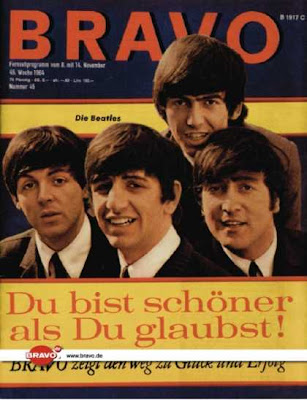
The Beatles on Bravo 1964

Groupie lifts the lid on the excesses of the Beatles and Rolling Stones

A groupie who was granted access to the inner sanctums of the Beatles and the Rolling Stones has lifted the lid on their hedonistic lifestyles in a new memoir.

Chris O'Dell had affairs with Sir Mick Jagger, Ringo Starr and Bob Dylan during the 1960s and 1970s while working as a personal assistant in the music business.
Now 62, she has written an autobiography in which she charts her years as a rock and roll hanger-on, which she describes as "like being given the keys to Disneyland".
She gained her first entry into the music world aged 20, after arriving in London from her home in Tuscon, Arizona with $100 in her pocket. She landed a job as an office assistant at Apple Records, at the height of Beatlemania.
Within months, O'Dell had hit it off so well with George Harrison that she moved in with him and his wife, Pattie Boyd, at their home in Henley-on-Thames.
In her book, she recalls the day that Harrison admitted he had been sleeping with Starr's wife, Maureen. "You know, Ringo, I'm in love with your wife," Harrison said as they sat at Starr's kitchen table. "Better you than someone we don't know," Starr shrugged.

O'Dell had her own three-month affair with Starr and claims that the band lived a drug-fuelled lifestyle. "We all drank and took coke, pot, amphetamines all the time," she said.
On one occasion, she shared a plane journey with John Lennon and Yoko Ono.
"The plane started hitting some turbulence and then John and Yoko started singing the Hari Krishna chant. So we just chanted our way to the earth, basically, until we landed. And I thought, well, if I die here at least I'll be on the front page."


Chris O'Dell and Keith Richards backstage in Nashville


After the Beatles broke up, O'Dell became a personal assistant to the Rolling Stones and joined them on their infamous 1972 tour. Of her fling with Jagger, she said: "If there had been a job description being employed by the Stones back then, I'm pretty sure it would have included a proviso that went something like this: sleep with Mick whenever he asks."
Two years later she was hired as a tour manager for Dylan and began an affair with him. She went on to marry the Hon Anthony Russell, son of the fourth Baron Ampthill. Starr is godfather to their son. Now married for a second time, O'Dell has retrained as a drugs counsellor.

The book is entitled Miss O'Dell: My Hard Days and Long Nights with the Beatles, the Stones, Bob Dylan, Eric Clapton, and the Women They Loved. O'Dell kept diaries of her rock star days but waited until Harrison's death in 2001 before beginning work on it.
She claims that Starr has given the book his blessing.
"We're in our sixties now, some of us are even creeping towards our seventies," she said. "Everybody is grown up enough to realise this is what happened. We're well past it. Ringo's attitude today is, fine, as long as you tell the truth."

By Anita Singh, Showbusiness Editor
© Copyright of Telegraph Media Group Limited 2009

Wirral songwriter completes George Harrison Beatles song 40 years on


It's not every day you find yourself writing a song with a former Beatle.
But Wirral singer/songwriter Dean Johnson found himself doing just that when he was asked to complete a fragment of a song originally written by George Harrison at the height of Beatlemania.
The original 10 lines were given to biographer Hunter Davies by George for inclusion in his Beatles biography published in the late 1960s, but were put aside and forgotten until recently.
They were picked up by BBC Radio Merseysides Spencer Leigh, who suggested that maybe a contemporary songwriter could make the fragment into a song. He approached Dean.
Spencer called me out of the blue and left a message saying he had an interesting proposition for me, explained Dean, from Oxton. I called him back and when he said he would like me to work on Georges unfinished song I found it unbelievable, tremendously exciting and above all a complete honour.
My brief was to follow Georges sentiment through to its conclusion. The words were both brutally honest and compassionate and Harrison was obviously writing from the heart.
I just tried by my best ability to get into the mind of someone in Georges position and I am so pleased that most people who have heard it, think I achieved a credible continuity with the original lyrics.
The original fragment was written by George when Hunter had asked each Beatle to submit a sample of their handwriting. It was then discarded as scrap paper from the floor of Abbey Road studio, where it is almost certain that it would have been thrown out by the cleaners if he had not picked it up.

When re-examining these papers he came upon the remarkable discovery.
The lyrics are of a personal nature and were first thought to be a song of unrequited love but in hindsight they seem to allude to Georges uneasy relationship with John Lennon.
On the reverse side of the lyric are instructions on how to reach Beatles manager Brian Epsteins country house in Sussex, written in Epsteins hand.
It is now in the British Librarys Beatles collection, along with more material loaned by Hunter who plans to donate everything to the library after his death.
The collection ranges from a fan club membership card to the lyrics of A Hard Days Night, written by John Lennon on the back of a birthday card to his son Julian.
Hunters biography, entitled The Beatles, is republished this month, containing the lost lines with the blessing of Georges estate.
The finished song, entitled Silence (is its own reply), was performed live during an interview with Hunter Davies on Spencer Leighs On The Beat programme.

Silence (is its own reply)

I'm happy to say that it's only a dream
When I come across people like you,
It's only a dream and you make it obscene
With the things that you think and you do.
You're so unaware the pain that I bear
And jealous for what you can't do.
There's times when I feel that you haven't a hope
But I also know that isn't true.
Every time I ask you why
Silence is its own reply
Its so hard to prove what I can do
Compared to someone like you
You make it look easy but you still tease me
When you have got nothing better to do
When the tears are falling and its dawning
The truth will ring out so clear
That no-ones above you and nobody can love you
Until all that pain disappears
Every time I ask you why
Silence is its own reply
By the time we have talked it over
Itis time to say goodbye

Beatles' Era - Richard Lester

Richard Lester (director) (born January 19, 1932) is an American-born British-based film director famous for his work with The Beatles in the 1960s.

Early years and television

Lester was born in Philadelphia, Pennsylvania He was something of a child prodigy, and at 15 began studies at the University of Pennsylvania, He started in television 1950, working as a stage hand, floor manager, assistant director, and then to director less than a year, because no-one else was around that knew how to do the work. In 1953, Lester moved to London and began work as a director in independent television, working for the legendary low cost television producers The Danziger Brothers on episodes of Mark Saber, a half-hour detective series.

A variety show he produced caught the eye of Peter Sellers, who enlisted Lester's help in translating The Goon Show to television as The Idiot Weekly, Price 2d. It was a hit, as were two follow-up shows, A Show Called Fred and Son of Fred.

Film career

A short film Lester made with Spike Milligan and Peter Sellers, The Running Jumping & Standing Still Film, was a favorite of The Beatles, and in particular John Lennon. When the band were contracted to make a film in 1964, they chose Lester from a list of possible directors. A Hard Day's Night showed an exaggerated and simplified version of The Beatles' characters, and proved to be an effective marketing tool. Many of its stylistic innovations survive today as the conventions of music videos, in particular the multi-angle filming of a live performance. Lester was sent an award from MTV as "Father of the Music Video." See IMDB for full list of Films.

Lester directed the second Beatles film Help! in 1965. He then went on to direct several quintessential 'swinging' films, including the sex comedy The Knack...And How to Get It (1965), which won the Palme d'Or at the Cannes Film Festival and Petulia (1968) (both with scores by John Barry), as well as the 1967 darkly surreal anti-war movie How I Won the War co-starring John Lennon, which he referred to as an "anti-anti-war movie"; Lester noted that anti-war movies still took the concept of war seriously, contrasting "bad" war crimes with wars fought for "good" causes like the liberation from Nazism or, at that time, Communism, whereas he set out to deconstruct it to show war as fundamentally opposed to humanity. Although set in World War II, the movie is indeed an oblique reference to the Vietnam War and at one point, breaking the fourth wall, references this directly.


In the 1970s, Lester directed a wide variety of films, including the disaster film Juggernaut (1974), Robin and Marian (1976), starring Sean Connery and Audrey Hepburn and the period romance Cuba (1979), also starring Connery. However his biggest commercial successes in this period were The Three Musketeers (1973) and its sequel The Four Musketeers (1974). The films were somewhat controversial at the time because the producers, Alexander Salkind and Ilya Salkind, decided to split the film into two after principal photography was completed. Many of the cast sued the Salkinds as a result, stating that they were only contracted to make one film.

Superman

As the release of Superman neared, production on Superman II was halted to concentrate on getting the first movie completed. After the first Superman film was released in late 1978, the Salkinds went back into production on Superman II without informing Superman's director Richard Donner and placing Lester behind the camera for the completion of the film. Although Donner had shot approximately 75% of the film, Lester jettisoned or re-shot much of the original footage, resulting in Lester receiving sole credit for directing Superman II. Gene Hackman, who played Lex Luthor, did not return, and Lester instead used a stunt double and an impersonator to loop Luthor's lines into footage of Hackman shot during Donner's tenure on Superman II. The footage filmed by Donner was later integrated into television versions of the film with Lester's footage. In November 2006, Donner's footage was reedited into Superman II: The Richard Donner Cut, using mostly Donner footage, with the only Lester footage being that which is necessary to cover scenes not shot during Donner's principal photography. Donner revealed on the new DVD of Superman II: The Richard Donner Cut that he has never heard from Lester since his firing after the completion of the first film.


Lester also directed Superman III in 1983. The third Superman film fared poorly with critics, with fans divided, and did not perform quite as well at the box office as the previous two movies had, although actually, the film still managed to be within the top 10 most successful films of 1983; the number of blockbuster sequels released that year (two 007 movies, Octopussy and Never Say Never Again, Return of the Jedi and Jaws 3) made for stiff competition for Superman III. Despite the competition, naysayers tend to overlook the financial success of the movie and deem it a flop. It is generally seen as the turning point where the series went into decline. As such, Lester is blamed by some fans for helping to ruin the Superman franchise.

Later years

In 1988, Lester reunited the entire Musketeers cast to film another sequel, The Return of the Musketeers. However, during filming in Spain, the actor Roy Kinnear, a close friend of Lester's, died after falling from a horse. Lester finished the film, then retired from directing, only returning to direct a concert film for friend Paul McCartney in 1991, Get Back.

In 1993, he presented Hollywood UK, a five-part series on British cinema in the 1960s for the BBC.

In recent years, director Steven Soderbergh has been one of many calling for a reappraisal of Lester's work and influence. Soderbergh wrote a 1999 book, Getting Away With It which consists largely of interviews with Lester.

Personal life

In Soderbergh's Getting Away With It, Lester reveals that he is a committed atheist and debates with Soderbergh (then an agnostic), largely based on the arguments of Richard Dawkins.

John Lennon & Richard Lester Behind the Scenes of How I Won the War


How I Won the War is a black comedy film directed by Richard Lester, released in 1967. The film stars Michael Crawford as bungling British Army Officer Lieutenant Earnest Goodbody, with John Lennon...
How I Won the War is a black comedy film directed by Richard Lester, released in 1967. The film stars Michael Crawford as bungling British Army Officer Lieutenant Earnest Goodbody, with John Lennon (Musketeer Gripweed), Jack MacGowran (Musketeer Juniper) Roy Kinnear (Musketeer Clapper) and Lee Montague (Sergeant Transom) as soldiers under his command. The film uses an inconsistent variety of styles — vignette, straighttocamera, and, extensively, parody of the war film genre, docu-drama, and popular war literature — to tell the story of 3rd Troop, the 4th Musketeers (a fictional regiment reminiscent of the Royal Fusiliers) and their misadventures in the Second World War. This is told in the comic/absurdist vein throughout, a central plot being the setting-up of an Advanced Area Cricket Pitch behind enemy lines in Tunisia, but it is all broadly based on the landings in North Africa in 1942 to the advance on the Rhine following Arnhem.

How I Won The War has never been critically well received, but its status as a curiosity — if only as John Lennons only nonBeatles film role — seems assured. Its collation of images and tableaux is darker and less structured than its anti-war contemporary Oh! What a Lovely War, the drama is not as terrifyingly unhinged as the later Catch-22, and it does not come across with the humane compassion of MASH. Though there are some memorable exchanges between characters, and fragments of battle scenes that carry a strangely disturbing ring of truth, the script is very largely composed of intentional nonsequiturs, mostly based on British Army slang, and this along with the ongoing barrage of textbook Brechtian estrangement techniques makes it perennially difficult to know what the film is aiming to do. Lester himself, acknowledging this, argued that most "anti-war" films still treat war in a rational manner, while he tried to disassemble it to the pure perversion of everything human he found it to be.

Continuing on the absurdist tone established in Help! and considering this film an artistic success, United Artists gave Richard Lester free rein to create his next film, the nuclear war satire The Bed-Sitting Room. The three films accidentally constitute a trilogy that has developed a cult audience since their initial releases between 1965-70.

The film was made on location in Spain in the autumn of 1966. It has been said "Strawberry Fields Forever" was written by Lennon on the set. The film's release was delayed by 6 months as Richard Lester went on to work on Petulia (1968), shortly after completing How I Won The War.

She Loves You: the Lost Beatles Track Story

by David Haber

What happened to the original masters of She Loves You and the subsequent making of Sie Liebt Dich is one of the biggest mysteries in the history and lore of the Beatles. This is my own theory.

The History of She Loves You

She Loves You was recorded at EMI Abbey Road Studio 2 on July 1, 1963. Mono mixing and editing was performed on July 4. Since the original tapes for these sessions no longer exist, all that Mark Lewisohn could say about this session in his book The Beatles Recording Sessions, besides the dates, was:

"Precise details of the recording takes no longer exist, but three reels of tape were filled in putting down She Loves You and its B-side I'll Get You..."

On January 29, 1964, while in France for live performances at the Olympia Theater, the Beatles recorded Komm, Gib Mir Deine Hand and Sie Liebt Dich for their German fans at a recording session at EMI Pathe Marconi Studios, Paris. The first takes of Can't Buy Me Love were also recorded during those Paris recording sessions that day.

While it is commonly known that the original rhythm (instrumental backing) track from I Want To Hold Your Hand was used to record Komm, Gib Mir Deine Hand, it is also commonly believed that the entire recording of Sie Liebt Dich was done completely from scratch. Quoting again from Lewisohn's Recording Sessions:

"First task was to add Komm, Gib Mir Deine Hand vocals to the English rhythm track of I Want To Hold Your Hand, mixed down from four-track to two-track. The 'best' versions were takes 5 and 7, with overdubbed handclaps, edited together later.

"For Sie Liebt Dich, the Beatles recorded a new rhythm track, the 1 July 1963 two-track tape having been scrapped once the mono master was prepared. This was done in 13 takes, onto which they overdubbed, in one take, the vocals in the rhythm left/vocals right pattern of their earlier two-track tapes."

Because the two-track master is missing, She Loves You exists only in mono, as it was never mixed into stereo.

In addition, Allen J. Weiner, in The Beatles Ultimate Recording Guide, agrees:

"Sie Liebt Dich was a completely different recording from She Loves You and included a new instrumental track."

My Revelation

I've always personally accepted the above descriptions of how Sie Liebt Dich was created. Compare the released versions of She Loves You and Sie Liebt Dich yourself, they do sound very different from each other.
Although She Loves You only exists in mono, there are stereo versions of Sie Liebt Dich on both the Parlophone and Capitol Rarities albums. These versions sound as Lewisohn describes the final Paris recordings above, rhythm track on the left and German vocals on the right.

When listening to this stereo version of Sie Liebt Dich recently, I thought it might be fun to try and make a fake stereo She Loves You by synching the mono She Loves You on one channel with the rhythm track from the stereo Sie Liebt Dich on the other. (Others have attempted to do this as well, one bootleg actually passed off such a synch job as "the missing stereo version of She Loves You".)

However, when I attempted to do this, I immediately noticed that the two tracks are possibly more than coincidentally the same.

Despite the accepted documentation, I have found strong evidence that the Sie Liebt Dich that was recorded on January 29, 1964 in Paris might be new vocals overdubbed onto the July 1, 1963 She Loves You rhythm track, in the very same way they made Komm, Gib Mir Deine Hand.

This means that even though the July 1, 1963 two-track master of She Loves You may now be destroyed or missing, I believe it could have still existed on January 29, 1964 for the making of Sie Liebt Dich.


Keys To The Puzzle

The key to proving that both tracks have identical origins is to hear them both at the same time. However, it is very hard to successfully play back She Loves You and Sie Liebt Dich together and keep them synchronized. I believe this is due to two major factors. These two factors are also very instrumental in understanding why, upon casual listening, the tracks seem to sound so different.

1. Tape Speed

Every release of Sie Liebt Dich is slightly faster than the Parlophone She Loves You. To add to the confusion, the Parlophone release is slightly faster than the American Swan and Capitol releases, which are similar. This makes the difference for American listeners even more acute. (Listen to the comparisons of the Swan She Loves You and the Odeon Sie Liebt Dich above.)

It is possible that the original speed difference is due to differences between the tape decks at Abbey Road where the rhythm track was recorded and those at Pathe Marconi in Paris where Sie Liebt Dich was produced (a difference which was later compounded when the mono mix of She Loves You made its way to America).

A turntable or tape recorder with a vari-speed function or a computer's sound editing program can be used to successfully match the speed of the two versions. When this is done, both versions become perfectly in tune musically with each other. This is an important fact. If they were totally separate recordings, played in the same key but at slightly different tempos, when corrected to match speeds, their musical keys would not match. But this is not the case.

The speed differential between the original Parlophone mix and the German mix may also be at least partially intentional, keep reading.

2. Tape Edits in Mono Mix

We can hear that the mono mix of She Loves You is very heavily edited. Sie Liebt Dich does not appear to be. Listen to this sound clip which contains three examples of edits in She Loves You from the version on the Past Masters 1 CD.

The first edit in the above version is slightly hard to hear, it takes place in the middle of the guitar after "you know you should be glad", this is approximately 1:15 into the song. The next two are much easier to hear, right before "pride can hurt you too" at 1:22 into the song, and then again right before "because she loves you" at 1:29 into the song.

These edits, and others, are in every release of She Loves You but they are easiest to hear on the Past Masters CD. Steps were taken during the mastering of earlier 45 and LP versions to hide the edits somewhat, this seems not to have been done when Past Masters was released.

The edits throw any synchonization attempts off, as they were done by hand and each physical tape edit possibly includes a tiny bit more of each recording than it should, or a tiny bit less. These slight editing mistakes are not big enough to notice upon casual listening, but are big enough to cause synch attempts to seem to drift in and out of synchronization as the edited version first includes tiny snippets of the original recording where it shouldn't, and then loses tiny bits later that should be there, when compared to the seemingly unedited Sie Liebt Dich.

A Controversial Theory

But why is the mono mix of She Loves You so highly edited, much more than any other early Beatles release? I have a theory as to why this is.

It is documented that at the time She Loves You was recorded, the Beatles were recording on a two-track tape machine. That means the song would have been recorded with the rhythm track on one channel and the voices on the other.

We also know that it took much time, especially in the early years, for George to work out his lead guitar parts, although once he worked out the part, he played very well. This is reason to believe that George's guitar might have been recorded separately from the rhythm track which was done first.

In the two-track days, for that to be accomplished, since both tracks were already taken up, one for the rhythm track and the other for the vocals, it would have been necessary to "mix down" both of these tracks to one track of a new tape, thereby opening up a new free track.

It's possible George Martin opted not to do this for two main reasons. First, a "mix-down" step would mean an additional tape generation, meaning the introduction of a lot of tape noise (hiss). Also, it meant relinquishing the ability to re-mix. Once mixed-down, the levels of the vocals to the rhythm track would be forever set and unchangeable, and it would be impossible, for example, to change something in the vocal without affecting the rhythm track.

Instead, it's possible to believe that George's lead guitar track was simply recorded on a separate tape, to be played back in synch with first two-track tape when making the mix. There is evidence they had done something similar to this earlier, on a smaller scale, with things like John's harmonica on From Me To You and Thank You Girl, where we know the harmonica is not part of the main rhythm track, because of tape evidence of the actual edit pieces, and differences in the mono and stereo mixes of the song.

If George's guitar had to be synched with the main tape when making the mono mix, that could explain why the mono mix is so heavily edited. It was way too difficult to get it all perfectly synchronized in one take, so they edited together all of the best attempts.

In addition, this perhaps explains why there is no stereo mix of She Loves You, because it would have been too hard to do, and there's no way they could do a stereo mix that sounded exactly like the mono one. There is documented evidence that George Martin did something like this again later, issuing I Am The Walrus in fake stereo rather than attempt a true-stereo mix because an effect created during the mono mix (the King Lear voice-over) could not be recreated in the same way.

I admit I have no proof that there was a separate George guitar track, it is only a theory. At the very least, upon the evidence of all the tape edits in the mono mix, the She Loves You master tapes must have been comprised of several separately recorded components which were assembled for the mono mix. This sheds some light on many of the lingering questions in the making of She Loves You and Sie Liebt Dich mystery.

Norman Smith, engineer for both She Loves You sessions

Putting It All Together

It's important to remember that all of the documenation we have on the making of both She Loves You and Sie Liebt Dich is shaky, at best. Taking a look again at the quote from Lewisohn:

"For Sie Liebt Dich, the Beatles recorded a new rhythm track, the 1 July 1963 two-track tape having been scrapped once the mono master was prepared. This was done in 13 takes, onto which they overdubbed, in one take, the vocals in the rhythm left/vocals right pattern of their earlier two-track tapes."

We know at least part of that account is wrong, the vocal overdubs were not accomplished in one take, as the outtake from Anthology proves.

I think it is reasonable to believe that the thirteen takes that Lewisohn describes it took to re-record the Sie Liebt Dich rhythm track could instead have been thirteen takes to successfully reconstruct the rhythm track for Sie Liebt Dich from the components of the original She Loves You master tapes. This process would have been very laborious, and could have easily taken thirteen tries, the very reason a stereo mix was abandoned originally.

At the same time, is it reasonable to believe it would have taken the Beatles thriteen takes to re-record the rhythm track for a song they already knew very well by this point?

If indeed some recombining of the master tapes was involved in recreating the She Loves You rhythm track, this could be the very cause of the speed differences between the two releases. It may have been necessary for them to slightly speed up the She Loves You two-track master in Paris as they were making the mix, in an attempt to make the various tape components match better.

Deciding For Yourself

Despite the difficulty due to the factors described above, it is still possible to synchronize She Loves You and Sie Liebt Dich enough to demonstrate the phenomenon of how alike they sound. When you listen to them synchronized, it sounds as if the lead guitar and bass guitar parts are identical throughout. In addition, the drum part also sounds like it is identical in several unique passages.

To help you explore the striking similarities between She Loves You and Sie Liebt Dich, I suggest to listen to the same segment of both songs, the Parlophone mono mix of She Loves You and the stereo mix of Sie Liebt Dich from the Parlophone Rarities LP.
Besides being generally alike, here are some specific things to look for:
The de-emphasized drum beat after the second "Yeah Yeah Yeah".
The lead guitar has an identical note-doubling in the phrase right before the vocal.
The unique drum break before "and you know..."
Extra notes in bass line under "but now she said she knows..."
The lead guitar phrases, the first of which starts sloppily.
When listening to these examples, try to focus on one instrument at a time. Listening in headphones makes it easier to focus on each instrumental element.

Also, listen for what is alike, rather than what is missing from one or other, as missing sounds can easily be explained by being "buried" in their respective mixes by other sounds or differences in the mixing and mastering processes.

After hearing the two versions of the song synchronized, and considering the details described above, it's my opinion that the two recordings, She Loves You and Sie Liebt Dich, were made using the same instrumental performance. However, we may never know the answer for sure. Many of the people involved are no longer with us, and it was years ago. Perhaps if more of the Sie Liebt Dich recording session (a bit of which is included above) is ever released from the EMI vaults, we may know if they really did record a new live rhythm track for Sie Liebt Dich that day in Paris in 1964. Until then, we'll just have to depend on our own ears.

And remember, it was George Martin who said "All you need is ears".

Fan's Arts: “Nowhere Man” animation


Animated video created by Stelos485 inspired by “Nowhere Man” from “Rubber Soul” (Dec 1965)

Fan's Arts: “Sgt. Pepper’s (Reprise)” animation


Arturo from Leon (Mexico) created this video animation in flash for a school project using “Sgt. Pepper’s (Reprise)” as soundtrack.

Why the Beatles Broke Up

Mikal Gilmore on his new investigation into the Fab Four's fall.

I came of age in the time that was also the age of the Beatles, and I've always been grateful for that simultaneity. Along with the Beatles, and no doubt because them, many of us grew into an awareness that shared tastes in music might also amount to shared community, and that community could amount to new ideals, new oppositions, new fun, art, fear and political power. Now, these years later, I think of the Beatles as one of the most romantic and dramatic exemplars of democracy that helped move youth culture in the 1960s: They were themselves a democratic unit — all for one, one for all, and in times of disagreement, they nonetheless enjoyed a fraternal sense of accord that made consensus a functional part of their shared dreams.

But democracy is always tenuous and, in any real way, ephemeral, and it was how the Beatles exemplified these latter qualities that is what made for the dynamics we saw at work in the Beatles' end story. By the time they came apart, no matter the personal differences and rivalries and any internal pain and madness, the Beatles were just too big and important to break up without saying something about the world that they had helped shape. As the 1960s' hopes of community and free-form democracy gave way to something harder and more bitter, the Beatles too fell prey to the dissolution, and they knew it. After all, they had believed so deeply in love as a means to personal and social redemption, there was no way they could leave each other without breaking both their times and each other's hearts.

This has all been observed in many ways in the past, and will be for generations to come. Yet even if it makes a sad sort of sense — a symbol of unity that ends, like the era it centered, in disunity — there will still always be something mysterious about why and how the Beatles came apart the way they did, in so much rancor and avarice. John Lennon always referred to the band's end as "a divorce," but that was simply how he justified his own leave-taking (and clearly, Lennon was no model for how to separate fairly from others, given how he left his first wife, Cynthia).

What actually happened, I've come to believe, was something different and worse than divorce. I started work on this story well over a year ago, making my way through over 65 texts and taking (exactly) 1,440 pages of notes. Not surprisingly, the various historians, critics, biographers, musicologists, sociologists and journalists I read had strong views about whose motives accomplished what in the debacle, who was guilty and who was simply helpless in the sweep of events. In truth, there were good guys and no villains, but because these were fallible people, they certainly made some grievous errors.

Through all my research, certain conclusions became inevitable, and they managed to surprise me a bit: The Beatles' end was an accident, a maneuver by John Lennon that went horribly wrong.
It's long been known that the Beatles in fact ended when, in September 1969, Lennon announced to his bandmates, to his wife Yoko Ono and to manager Allen Klein that he was leaving his famous group, even as the album Abbey Road was meeting with the biggest sales the Beatles had yet known. Several months later, as this article chronicles, Paul McCartney also announced he was leaving the Beatles, though unlike Lennon, he said so publicly.

Though there are numerous moments in the group's chronology of dissolution that were crucial events, this move by Paul was perhaps the most critical of them all. He had loved the Beatles more than the others had — he had certainly loved John more than John had loved him — and it was due to Paul's resourcefulness and tenacity that the Beatles held together and moved forward so remarkably after the death of the manager who had made them famous, Brian Epstein. Though Lennon is more commonly regarded as the Beatles' true genius (which is inarguable: he wrote the bulk of their masterpieces and until the last couple years of their career, wrote the best tracks on their albums), it is also fair to say that without McCartney, the Beatles would not have mattered in history with such ingenuity and durability. Also, unlike Lennon, McCartney understood that the Beatles' four members would never create so much wonder separately as they had collectively. So for Paul McCartney — the only Beatle who had never left the group in a fit of pique or out of whim — to leave meant, in fact, the Beatles were over. He wasn't about to play any games about his love for what the Beatles were, nor was he going to dishonor his own pain.

McCartney had simply been forced into an impossible position by John Lennon, George Harrison and Allen Klein. At least two of those men should have loved Paul as much as he loved them, but instead they had come to resent what they saw as his drive and his domineering ways. Who knows what Lennon and Harrison thought would have become of the Beatles had it not been for McCartney — the only opinion they ever offered on the matter was that they had never expected to survive past Epstein's demise. The fact that they did is also what made them great forever, but no doubt in the midst of their unprecedented reality, any outside perspective was impossible; they were, after all, a notoriously insular outfit.

To the degree that any of this is tragedy — given that all things must pass — then it's indeed a manifold tragedy. Harrison and Lennon were profound men who understood the necessity for hope and fellowship, and yet they were also men who could be profoundly petty and ungrateful. Both of them early on came to dislike the reality of the Beatles' massive audience — "Fucking bastards, sucking us to death," John Lennon told Rolling Stone in 1970 — and both men became uncharacteristically obsessed with financial eminence near the group's end.

But what I found most troubling, most tragic, in all of this was two things: Both Lennon and Harrison (Lennon, clearly, in particular) did their best to sabotage the Beatles from mid-1968 onward, and when it all came irrevocably apart, I believe that both men regretted what they had wrought. I don't think that John Lennon and George Harrison (but Lennon, again, in particular) truly meant the Beatles to end, even though they might not have known it in the moment. I think they meant to shift the balance of power, I think they meant for the Beatles to become, in a sense, a more casual form of collaboration, and I think they clearly intended to rein in Paul McCartney. But they overplayed their hand and — there's no way around it — they treated McCartney shamefully during 1969, and unforgivably in the early months of 1970.

The immediate aftermath was as dramatic as everything that led up to it, though that isn't something we had the room to track much in this article, given its already considerable length. Lennon was furious and hurt when Paul said he was leaving — he too knew there would be no repairing this, even though he had already been indicating he thought the band would resume — and he and McCartney soon launched into some sour exchanges in interviews and in song.

When McCartney sued to dissolve the band's partnership, the three other Beatles claimed in court papers that they saw no reason to dissolve, that there was no real incompatibility that would prevent them all from continuing to make music together. They were saying this for legal and financial reasons, of course, but on some level, John Lennon, George Harrison and Ringo Starr almost certainly meant it. They had thrown away something special, and the man they chose to align themselves with, accountant and manager Allen Klein, turned out to be somebody they lost faith in. After that happened, they again had Paul McCartney to thank, because his legal actions at the end probably saved their legacy. But the other Beatles never apologized to McCartney for how they handled him in 1970. Some things healed with time, but some losses were eternal. Near the end of his life, John Lennon said, "My partings are not as nice as I'd like them to be. I regret a bad taste to it."

I realize there's an unseemly aspect to concentrating on how terribly the Beatles ended. Clearly, their music outshines the disaster and it always will. And though Lennon and McCartney no longer collaborated in the same ways in the group's last few years, their presence together as they continued to make music, including their contrasts, was still a partnership — one that was too often missed in their subsequent music apart.

Unbecoming or not, though, I've never come across a story that fascinated or moved me more than this particular one. The end of the Beatles was convoluted and acrimonious, but it was also transcendent: No matter their problems, no matter how much they viewed one another with suspicion in their last year or two, the Beatles still knew how to talk to each other through their music, and nobody else has truly matched that heart-to-heart they achieved. Describing working with them at the very end, on Abbey Road, their longtime producer George Martin said, "There was an inexplicable presence when all four were together in a room. Their music was bigger than they were."

That presence went well beyond the confines of room; it was a presence in the world at that time. Better than that, it was a force in history; it made possible the world we now live in, and nothing will ever unmake that. I will always be grateful to have lived in the time of the Beatles.

©Copyright 2009 Rolling Stone

Why Beatles stopped touring


From Beatles Anthology DVD.